
EUDR compliance software for operators and traders
Connect supplier, origin, geolocation, risk and declaration evidence before relevant products are placed on the EU market or exported.
UCVreg helps operators and traders structure due-diligence data, document risk and mitigation decisions, and preserve the evidence behind each Due Diligence Statement or simplified declaration.

EUDR, explained
What is EUDR?
EUDR is an EU law that requires businesses to make sure the products they sell in, or export from, the EU are not linked to deforestation. It covers certain products made from or containing cattle, cocoa, coffee, oil palm, rubber, soya or wood. The exact scope depends on the product and its Annex I customs code.
What is an EUDR Due Diligence Statement?
Where required, a Due Diligence Statement is an electronic operator declaration submitted through the EU Information System. It is supported by traceable information, risk assessment and, where necessary, mitigation records; it is not a certificate or a complete proof package.
How the EUDR workflow supports compliance teams
What does UCVreg EUDR compliance software help teams organize?
It organizes supplier, origin, plot, geolocation, risk and declaration evidence so teams can review the record behind an EUDR due-diligence decision.
Does UCVreg automatically submit Due Diligence Statements to the EU system?
The demonstrated workflow prepares and reviews DDS evidence and PDF records in this system; it does not submit DDS to the EU Information System. The operator remains responsible for the filing decision and human review.
Can the workflow support a compliance readiness review?
Yes. Use the compliance check to discuss your product scope, supply-chain evidence and review process with the UCVreg team.
Where can I verify the current EUDR dates and scope?
Use the official European Commission reference linked on this page and confirm the current legal position for your organisation.
Which commodities does the EUDR workflow cover?
The page covers cattle, cocoa, coffee, oil palm, rubber, soya and wood. Confirm the relevant Annex I product scope and CN code for your case.
What dates should micro and small operators check?
For most operators, the applicable date is 30 December 2026. Micro and small operators for products not previously covered by the EU Timber Regulation follow the later date of 30 June 2027; products previously covered by EUTR remain on the general date. Confirm the current legal position for your organisation.
Can teams bring supplier or ERP records into the workflow?
The workflow includes supplier-system and ERP import capability for review. Confirm supported source formats and the operating model with the UCVreg team.
See the EUDR review workflow in action
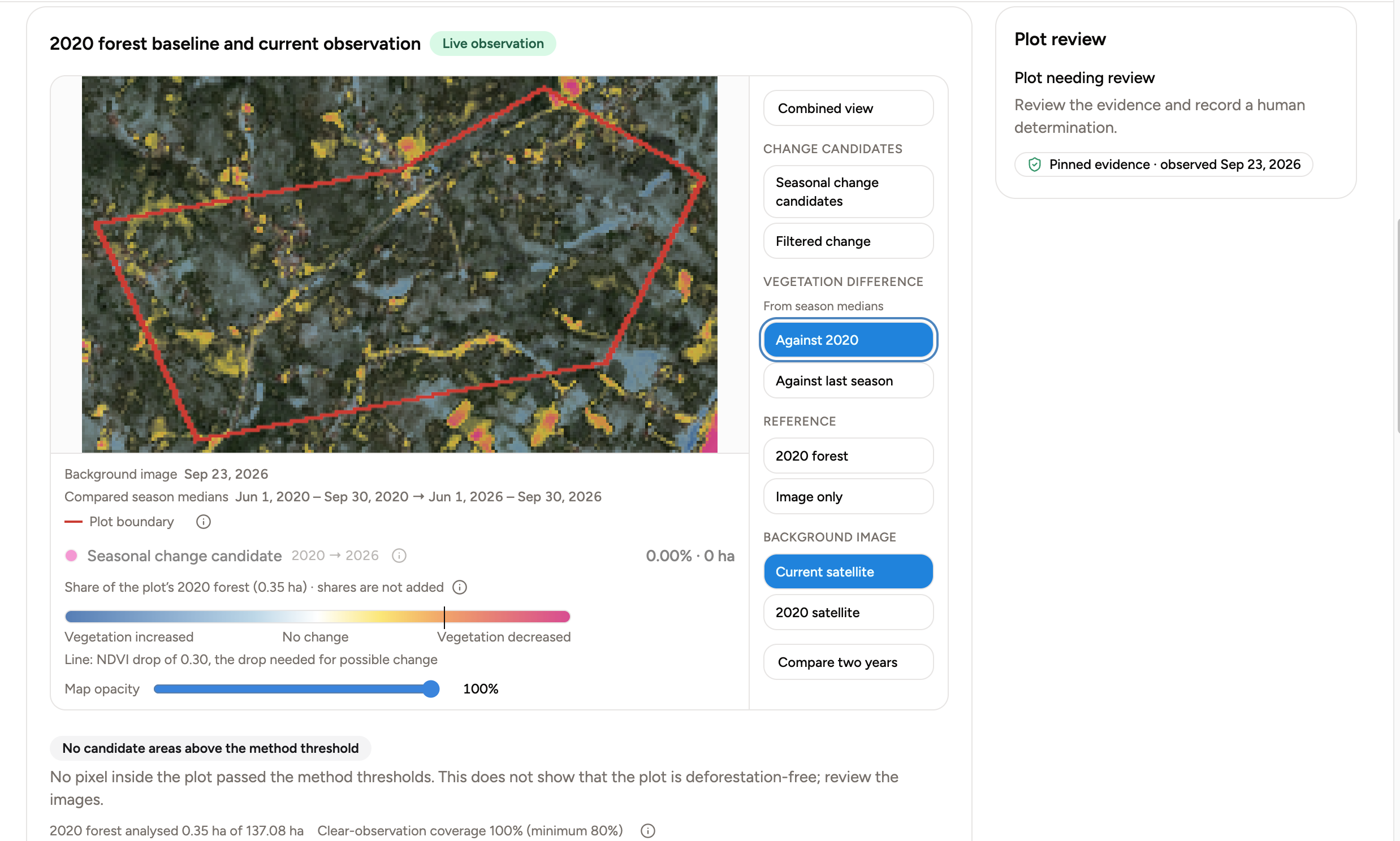
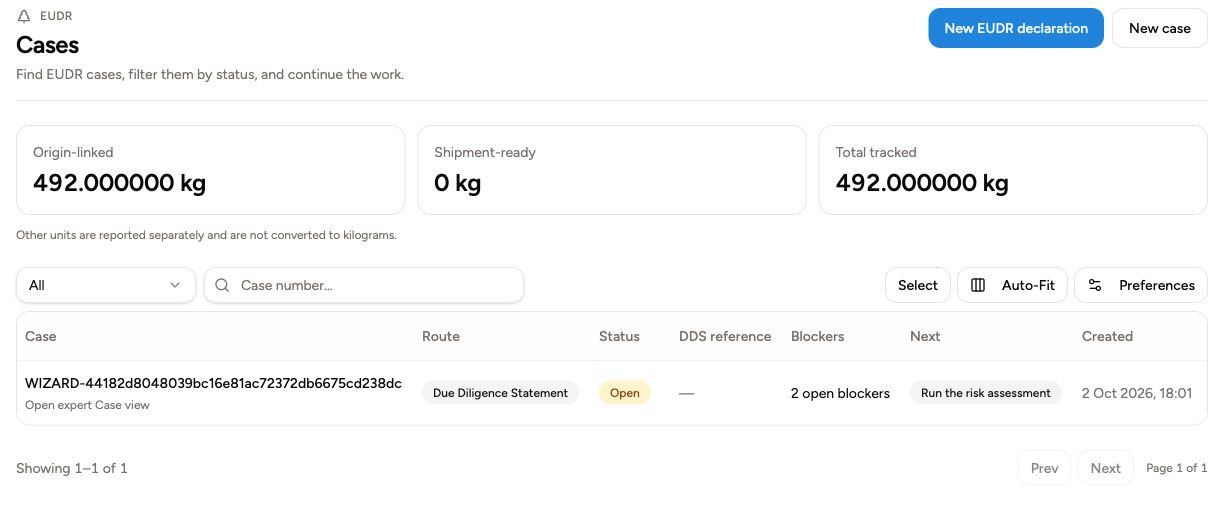
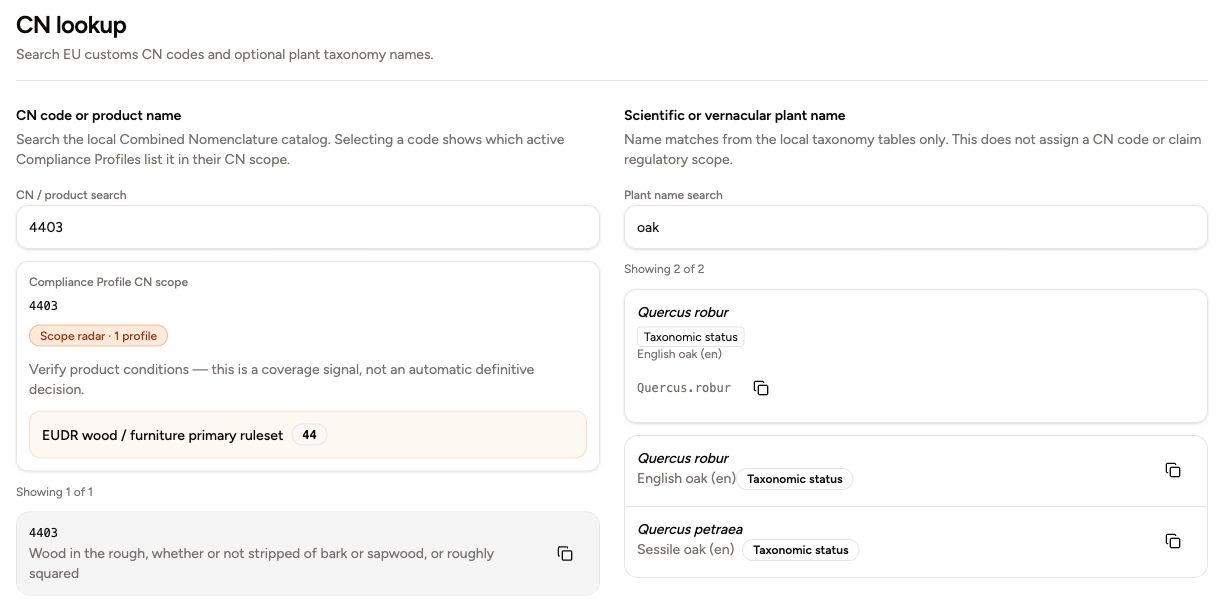
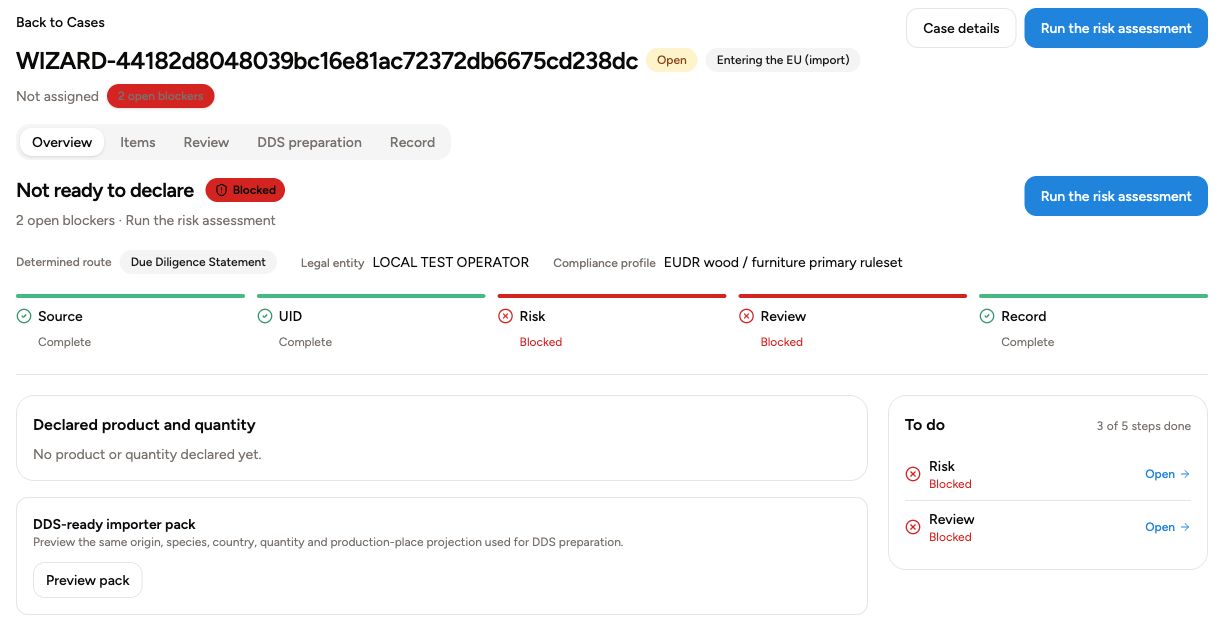
These real demo screens show evidence review, case context, classification lookup and workflow progress. They illustrate a human review process, not legal approval.
What the EUDR workflow covers
Available now
UCVreg provides versioned evidence, integrity verification and controlled access for the EUDR workflow, so teams can keep the record behind each review together.
EUDR workflow coverage
The workflow covers supplier and plot records, risk documentation, DDS evidence packaging and inspection reconstruction. Confirm the fit for your operating model with the UCVreg team.
Who is affected, what is covered and when it applies
EUDR obligations differ by role, product and organisational size. Coverage depends on relevant products and the applicable CN/HS codes in Annex I — not on a commodity label alone.
Who this is for
Upstream operators
First placers of relevant products on the EU market, responsible for collecting origin and due-diligence evidence.
Downstream operators and traders
Actors who further place or make available relevant products and must maintain declaration references and supporting evidence.
Micro and small primary operators
May use simplified declaration routes where the Regulation allows; duties still depend on product and role.
Commodity coverage
Relevant products are defined by Annex I / CN codes. The seven commodity groups below are the headline categories; exact coverage depends on the product you place or export.
Application timetable
Last reviewed: August 2026- 30 December 2026Large and medium operators
- 30 June 2027Micro and small operators
- 30 December 2026Micro and small operators already covered by the EU Timber Regulation
EUDR timelines can change. Confirm the current Commission position before treating a date as final for your organisation.
How EUDR due diligence works
EUDR is an operating model: collect information, assess risk, mitigate where needed, approve, submit a declaration and retain reconstructable evidence.
- 01
Collect information
Supplier identity, product and lot references, origin data and supporting documents enter a structured intake — including geolocation for plots or cattle establishments where required.
- 02
Assess risk
Evaluate deforestation and legality risk using documented criteria. A geospatial signal alone is not a negligible-risk conclusion.
- 03
Mitigate and approve
Record mitigation actions, exceptions and who approved the risk decision before declaration.
- 04
Submit the declaration
Prepare a Due Diligence Statement or simplified declaration with the evidence package that supports it.
- 05
Retain evidence
Keep supplier, plot, risk, mitigation and declaration references retrievable for the retention period — typically five years.
Operational requirements sit inside that workflow:
- Supplier intake and evidence gaps
- Plot or establishment geolocation
- Supply-chain and lot traceability
- Documented risk decisions
- Five-year evidence retention
Where EUDR programmes usually break
- Missing or unmatched geolocation
- Incomplete supplier evidence
- Unexplained risk decisions
- Disconnected DDS or Information System references
Plots, legality and what risk actually means
EUDR often requires geolocation of production plots or cattle establishments, plus legality evidence against the applicable cut-off and national rules.
Plot and establishment geolocation
Points or polygons tied to the commodity lot — not a free-text farm name.
Cut-off and legality
Evidence must support deforestation-free status after 31 December 2020 and legality under relevant production-country rules.
Signal versus conclusion
A map overlay can flag risk. A negligible-risk conclusion still needs a documented assessment and, where required, mitigation.
Illustrative geolocation view
Evidence workflowSuppliers, plots and risk review in one reconstructable view.
EUDR evidence workflow for operators and traders
UCVreg helps operators and traders structure EUDR records, connect supplier and plot evidence, and preserve the review history behind each declaration.
Versioned evidence
Decision history
Integrity verification
Review supplier, plot, DDS and inspection evidence in one workflow, with the operating model and filing decision remaining under the operator’s control.
Explore the platformTraceability is a data structure
EUDR is about preserving relationships between physical goods and regulatory decisions — not filing PDFs in a folder.
Those links must survive supplier changes, system upgrades and later inspection.
From preparation to possible enforcement
Due diligence is tested when goods move and when authorities ask for the evidence behind a declaration.
Preparation
Evidence is collected, risk is documented and a declaration is ready before placement or export.
Customs or market placement
Relevant products enter the EU market or export flow with declaration references available for checks.
Later inspection
Authorities may request geolocation, supplier chain and risk rationale. Incomplete reconstruction can lead to delays, market restrictions or other enforcement exposure — not only an automatic hold.
Commercial continuity risks
- Border delays and holding costs
- Market-access disruption
- Commercial impact with buyers and retailers
EUDR readiness checklist
- 1
Scope role and products
Confirm whether you act as operator or trader and which Annex I products apply.
- 2
Map suppliers
Identify who must provide origin, legality and geolocation evidence.
- 3
Prepare geolocation intake
Decide how plots or establishments will be collected, validated and linked to lots.
- 4
Define risk governance
Who assesses risk, who approves exceptions and what gets recorded.
- 5
Plan systems and approval
Connect ERP/procurement data paths and assign declaration approval responsibility.
Guides for timelines, evidence and preparation
These resources cover EUDR timelines, evidence requirements and implementation preparation.
Why structured evidence chains matter when authorities ask for origin and risk rationale.
ESPR and EUDR timingWhen the rules apply and how to prepare programmes from today.
EUDR compliance guide for furniture manufacturersA practical guide to wood, MDF, particleboard, reclaimed material and supplier-origin traceability.
Cattle EUDR guideEUDR evidence and traceability considerations for cattle supply chains.
Cocoa EUDR guideEUDR evidence and traceability considerations for cocoa supply chains.
Coffee EUDR guideEUDR evidence and traceability considerations for coffee supply chains.
Oil palm EUDR guideEUDR evidence and traceability considerations for oil palm supply chains.
Rubber EUDR guideEUDR evidence and traceability considerations for natural rubber supply chains.
Soya EUDR guideEUDR evidence and traceability considerations for soya supply chains.
Timber EUDR guideEUDR evidence and traceability considerations for timber supply chains.
Calculate your product risk and get your free report.
A few simple questions. They show which product rules may need a look before a sale, launch, or supplier call gets stuck.
Direct Rule Screening
Instant applicability check across ESPR, DPP, EUDR, PPWR & Battery Regs.
Risk & Gap Exposure
Identify supplier data missing links and customs audit bottlenecks.
Free Audit Report
Receive a structured, actionable executive roadmap with zero obligation.
Review your EUDR evidence workflow
Request an EUDR demo or start a compliance check to map your supplier, plot, risk and declaration evidence needs.