EUDR-Daten zur Rückverfolgbarkeit und Compliance von Palmöl
Verbinden Sie Ölpalmenplantagen, Lieferungen frischer Obstbündel, Rohpalmölmühlen, Raffinerien, oleochemische Verarbeiter, Lieferantentransaktionen und Legalitätsnachweise für die EUDR-Due-Diligence.
UCVreg unterstützt Palmölimporteure, -händler, -raffinerien, Konsumgüterhersteller und Einzelhändler bei der Strukturierung entwaldungsfreier Lieferkettendaten.
Der EU-Rechtsrahmen für Palmöl
Geltungsbereich und Anwendungstermine für Palmöl
Die EU-Entwaldungsverordnung gilt für Ölpalmprodukte, die in Anhang I der EUDR aufgeführt sind, einschließlich Ölpalmnüssen und -kernen, rohem und raffiniertem Palmöl, Palmkernöl, Ölkuchenrückstände, Glycerin und bestimmte industrielle Fettsäuren.
Gemäß der EUDR müssen Palmölrohstoffe entwaldungsfrei sein (also auf Flächen angebaut werden, die nach dem 31. Dezember 2020 nicht abgeholzt wurden), in Übereinstimmung mit den örtlichen gesetzlichen Umwelt- und Konzessionsgesetzen hergestellt werden und einer Due-Diligence-Erklärung unterliegen.
Die meisten EUDR-Verpflichtungen gelten ab dem 30. Dezember 2026 für große und mittlere Betreiber. Für Unternehmen, die als Kleinst- oder Kleinunternehmen gegründet wurden, gelten die Pflichten ab dem 30. Juni 2027.
Plantagengeolokalisierung und Mühlenversorgungsschuppen
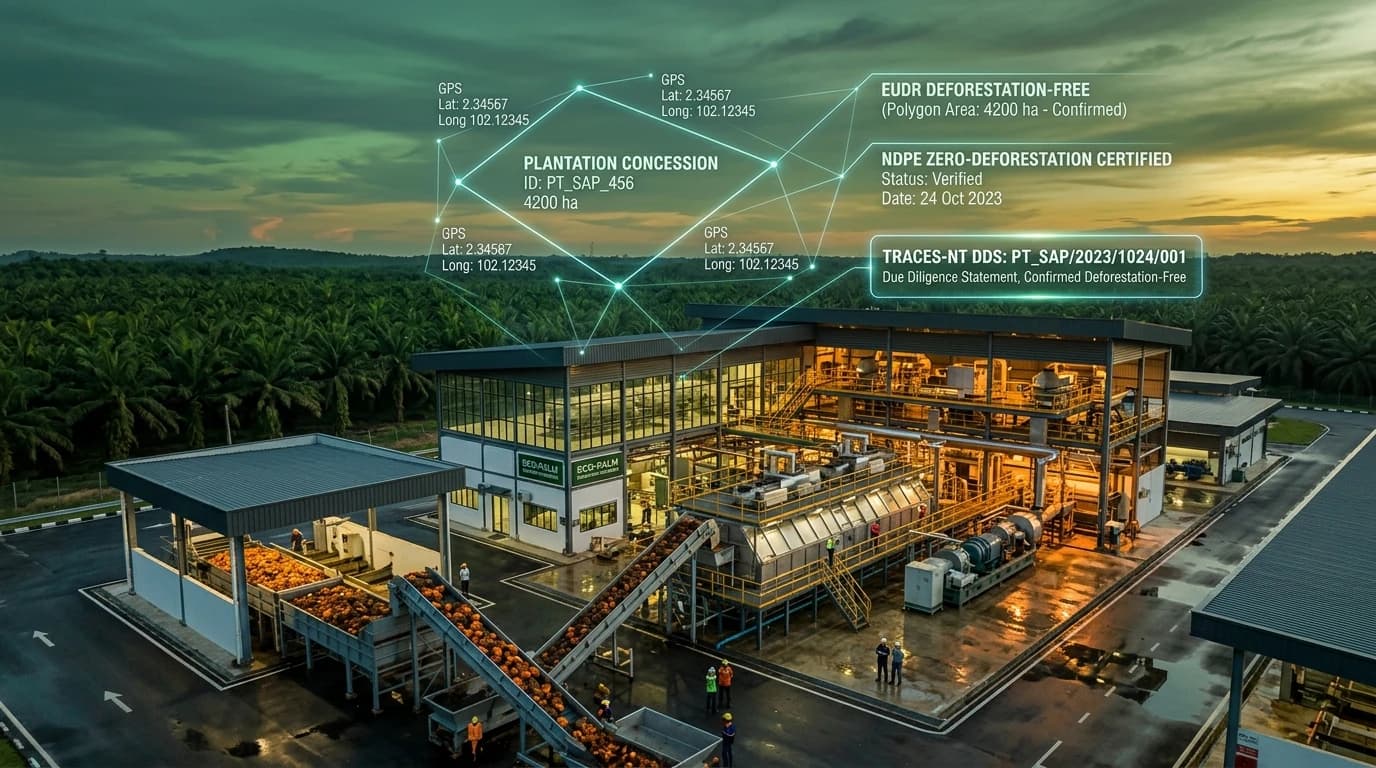
Betreiber müssen GPS-Polygonkoordinaten für alle Palmölplantagen und Kleinbauerngrundstücke erfassen, die frische Obststräuße (FFB) liefern:
In Zertifizierungssystemen übliche Massenbilanzmodelle sind zum Nachweis der EUDR-Konformität nicht zulässig; physische Trennung oder Identitätswahrung ist erforderlich.
- ✓Konzessionsgrenzenpolygone und Kleinbauernparzellenkoordinaten (Elaeis guineensis)
- ✓Rückverfolgbarkeit von Plantagenparzellen über CPO-Extraktionsmühlen bis hin zu Großtanks
- ✓Keine Umwandlung von Primärwäldern oder Torfgebieten mit hohem Kohlenstoffbestand nach dem 31. Dezember 2020
- ✓Konzessionsgenehmigungen, Umweltverträglichkeitsprüfungen (AMDAL/EIA) und FPIC-Vereinbarungen
- ✓Elektronische Sorgfaltspflichterklärungen, die im EU TRACES-NT-System eingereicht werden
EUDR-Pipeline für Geolokalisierung und Sorgfaltspflicht
Durchgängig verifizierter Workflow von der Lieferantendatenerfassung bis zur EU-Marktzulassung
Geolokalisierung der Fläche
GPS und PolygoneErfassen Sie Polygonkoordinaten für landwirtschaftliche Parzellen (>4 ha) und Punktkoordinaten (<4 ha) über alle Lieferkooperativen hinweg.
Entwaldungsprüfung
Copernicus-SatellitendatenAutomatischer räumlicher Abgleich mit Waldreferenzdaten vom 31. Dezember 2020 zum Nachweis von Entwaldungsfreiheit und gesetzlicher Legalität.
Sorgfaltspflichterklärung
TRACES-NT-RegisterÜbermitteln Sie verifizierte Sorgfaltspflichterklärungen an die EU-Plattform TRACES-NT und erzeugen Sie unveränderliche Referenznummern.
Zollabfertigung
MarktfreigabeÜbermitteln Sie überprüfbare DDS-Referenzcodes an Zollbehörden, Hafenlogistik und EU-Käufer.

Wo Konformitätsdaten für Palmöl lückenhaft werden und wie UCVreg die Vorbereitung unterstützt
Kartieren Sie riesige Plantagenkonzessionen und Kleinbauernnetzwerke
Rohpalmölmühlen beziehen zusammen mit Tausenden von unabhängigen Außenanbauern frische Fruchtbündel von Konzessionen des Unternehmens.
Erfassen Sie Multi-Polygon-Konzessions-Shapefiles und Kleinbauernkoordinaten in einer verifizierten Geodatenbank.
Stellen Sie sicher, dass es keine Abholzung mehr gibt und Torfmoore geschützt werden
Der Nachweis, dass es nach Dezember 2020 keine Abholzung von Wäldern und keine Torfentwässerung mehr gibt, erfordert eine multispektrale Baumkronen- und Feuchtigkeitsanalyse.
Führen Sie ein automatisiertes räumliches Screening anhand offizieller Copernicus-Baumbedeckungs- und Torfbodenverteilungskarten durch.
Spuren des Massentransports von Flüssigkeiten und oleochemischen Fraktionen
Rohöl wird in Großtanks, Hochseeschiffen, Raffinerien und oleochemischen Spalttürmen gemischt.
Sorgen Sie für eine strikte identitätserhaltende und getrennte Chargenverfolgung, die raffinierte Fraktionen mit den Ursprungsmühlen und Parzellen verbindet.
Verwalten Sie umfangreiche TRACES-NT-DDS-Anmeldungen
Exportsendungen enthalten Tausende einzelner Farmpolygone, die fehlerfrei an TRACES-NT übermittelt werden müssen.
Automatisieren Sie die Nutzlastgenerierung für Due-Diligence-Erklärungen mit Vorvalidierung und direkter TRACES-NT-API-Konnektivität.
Regulatorische Fakten
Allgemeine Wirtschaftsakteure müssen die EUDR-Sorgfaltspflicht ab dem genannten Stichtag erfüllen.
30. Dezember 2026
Quellenangabe: Regulation (EU) 2025/2650 amending Regulation (EU) 2023/1115
Anhang-I-Ergänzungen für löslichen Kaffee und bestimmte raffinierte Palmöelfraktionen gelten ab dem genannten Stichtag, vorbehaltlich der Prüfung.
30. Dezember 2027
Quellenangabe: Commission Delegated Regulation amending Annex I (Soluble coffee, refined palm oil fractions)
Fragen zum Sektor
Welche Informationen und Nachweise sollten die Teams vorbereiten?
Verbinden Sie Ölpalmenplantagen, Lieferungen frischer Obstbündel, Rohpalmölmühlen, Raffinerien, oleochemische Verarbeiter, Lieferantentransaktionen und Legalitätsnachweise für die EUDR-Due-Diligence. Allgemeine Wirtschaftsakteure müssen die EUDR-Sorgfaltspflicht ab dem genannten Stichtag erfüllen. (30. Dezember 2026). Anhang-I-Ergänzungen für löslichen Kaffee und bestimmte raffinierte Palmöelfraktionen gelten ab dem genannten Stichtag, vorbehaltlich der Prüfung. (30. Dezember 2027).
Bei welchen Produkten und Organisationsrollen sollten die Teams den Anwendungsbereich prüfen?
Umfasst Palmnüsse, rohes Palmöl, raffinierte Fraktionen, Palmkernöl, Palmölkuchen und industrielle Monocarbonfettsäuren. Der Anwendungsbereich muss anhand des einschlägigen KN-/HS-Codes geprüft werden. Die Pflichten hängen anschließend vom Produkt, der Markttätigkeit, der Unternehmensgröße und davon ab, ob das Unternehmen als Marktteilnehmer, Händler oder nachgelagerter Akteur handelt.
Wie sollten die relevanten Daten und Nachweise verwaltet werden?
Erfassen Sie Multi-Polygon-Konzessions-Shapefiles und Kleinbauernkoordinaten in einer verifizierten Geodatenbank.
Wo sollten die Teams beginnen?
Bauen Sie eine kontrollierte Grundlage für Plantagenkonzessionspolygone, Mühlenlieferbücher, Torflandverifizierung und TRACES-NT-DDS-Einreichungen.
Geltungsbereich
1207 10 001511 101511 901513 211513 292306 60 003823 11 003823 12 00Umfasst Palmnüsse, rohes Palmöl, raffinierte Fraktionen, Palmkernöl, Palmölkuchen und industrielle Monocarbonfettsäuren.
Die Sorgfaltspflicht gilt ab dem 30. Dezember 2026 für große Betreiber und ab dem 30. Juni 2027 für Kleinst- und Kleinunternehmen.
Sehen Sie auf unserer Seite, wie UCVreg die Überprüfung von Plantagenpolygonen mit der Nachverfolgung von Raffinerie-Chargenbüchern integriert Übersicht über die Due-Diligence-Prüfung von Palmöl.