
Données de préparation ESPR et de traçabilité pour l’acier
Préparez les données relatives aux produits fer et acier, aux matériaux, au carbone et à la traçabilité pour les futures exigences d’éco-conception de l’UE et les passeports numériques de produit.
UCVreg helps steel producers, processors, importers and downstream manufacturers structure compliance information, connect regulatory claims to evidence and maintain verifiable product records across complex supply chains.
Le cadre réglementaire de l’UE pour Acier
ESPR Iron and Steel Requirements
The Ecodesign for Sustainable Products Regulation establishes the framework for introducing product-specific sustainability, performance and information requirements.
Iron and steel are priority intermediate products in the ESPR Working Plan 2025–2030. The Commission’s current indicative timeline places adoption of the iron-and-steel delegated act in Q4 2026.
The 2026 impact-assessment process has examined potential information and performance requirements concerning areas such as carbon footprint, recycled content, material characteristics and substances that may impede recycling.
These remain policy areas under development not final obligations. The delegated act will determine the covered products, requirements, calculation and verification rules, transition period and application date.
Iron and Steel Digital Product Passport
Any mandatory Digital Product Passport requirements for iron and steel will be established through the future delegated act.
Depending on the final requirements, a steel DPP may include:
The final data fields, product granularity, access permissions and technical specifications have not yet been confirmed.
The EU DPP Registry became operational on 20 July 2026, but this does not make steel Digital Product Passports mandatory today. The Commission indicates that economic operators will receive a transition period of at least 18 months after the relevant ESPR delegated act is adopted.
- ✓Product identification and classification
- ✓Manufacturer or responsible economic operator
- ✓Technical and material information
- ✓Information supporting circularity
- ✓Recycled-content information
- ✓Sustainability-related product information
- ✓Documentation supporting compliance and traceability
Parcours ESPR du passeport numérique de produit
Parcours vérifié de bout en bout, de l’intégration des données fournisseur à la mise sur le marché de l’UE
Intégration des nomenclatures et matériaux
Données de chaîne d’approvisionnementCollectez les compositions de fibres et matériaux à plusieurs niveaux, les taux de contenu recyclé et les déclarations d’essais fournisseurs.
Validation de l’écoconception
ESPR et durabilitéVérifiez la durabilité du produit, les seuils chimiques SVHC, les limites de microplastiques et les règles de l’article 23 relatives aux invendus.
Enregistrement au registre DPP
Passerelle décentraliséeEnregistrez les passeports produits cryptographiques sur la passerelle DPP de l’UE avec des droits d’accès fondés sur les rôles.
Vérification du support de données
GS1 QR / matrice 2DApposez des supports de données 2D persistants, accessibles aux consommateurs, réparateurs professionnels, recycleurs et autorités douanières.
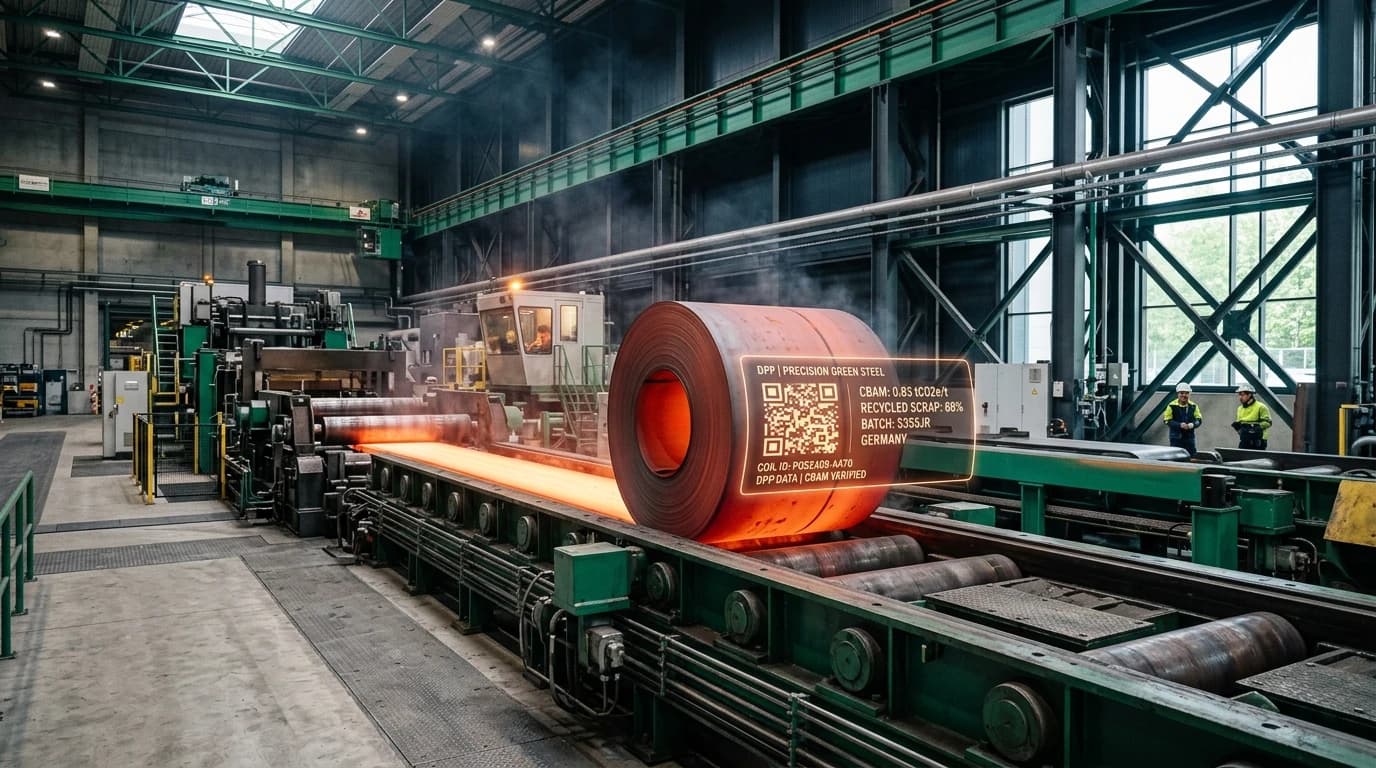

Carbon Border Adjustment Mechanism
The definitive phase of the EU Carbon Border Adjustment Mechanism began on 1 January 2026 and covers specified imports of iron and steel.
EU importers or their indirect customs representatives whose relevant imports exceed the single mass-based threshold of 50 tonnes during a calendar year must obtain authorised CBAM declarant status. The threshold concerns the applicable CBAM goods rather than a separate 50-tonne allowance for every individual steel product classification.
Authorised CBAM declarants must report the embedded emissions associated with covered imports and surrender the corresponding number of CBAM certificates in accordance with the applicable annual process. Where an eligible carbon price has already been paid in the country of production, a corresponding deduction may be claimed subject to the CBAM rules and supporting evidence.
CBAM and the future steel DPP may use related product, facility and emissions information, but they are separate legal regimes with different systems, methodologies and reporting processes.
EU Steel Regulation and Import Controls
Regulation (EU) 2026/1384 has applied since 1 July 2026, replacing the previous EU steel safeguard measure that expired on 30 June 2026.
The regulation establishes:
Imports from European Economic Area countries are excluded from the measure. The precise quota allocation depends on factors including product category, trading partner and applicable country-specific or residual quotas.
A targeted consultation on the first product-scope review opened on 30 July 2026 and closes on 30 September 2026. The Commission must assess by 31 December 2026 whether specified additional steel products should be brought within the regulation’s scope.
These are trade and customs controls not ESPR or Digital Product Passport requirements. Product, classification and origin evidence may support both areas of compliance.
- ✓Duty-free tariff quotas totalling 18.3 million tonnes per year across 30 steel-product categories
- ✓A 50% duty on imports above the applicable quotas
- ✓A melt-and-pour information requirement identifying where the steel was first melted and poured into its initial solid form
- ✓A mechanism for reviewing the regulation’s product scope and effectiveness
Où les données de conformité de Acier se fragmentent et comment UCVreg accompagne la préparation
Structure complex steel products and classifications
Steel may be managed across grades, forms, dimensions, production routes, heats, batches and downstream product classifications.
Connect steel product records to grades, specifications, materials, heats, batches, suppliers and production facilities instead of relying on disconnected certificates and spreadsheets.
Link carbon and recycled-content values to evidence
Carbon-footprint and recycled-content values may depend on production facilities, reporting periods, methodologies, supplier information and supporting calculations.
Link each recorded value to its facility, methodology, reporting period and source evidence, with human review before approval or publication. UCVreg preserves reported information and evidence but does not replace an approved calculation methodology or independent verification.
Govern data across separate regulatory requirements
ESPR, CBAM, steel import controls and downstream product legislation may require related product, origin and emissions information through different legal processes.
Reuse governed product, supplier and facility information across separate regulatory profiles while keeping each requirement, approval and publication state distinct. UCVreg does not replace customs declarations, CBAM submissions or official reporting systems.
Preserve changing product and evidence records
Product specifications, suppliers, carbon values, classifications and supporting documents can change between production runs.
Maintain versioned regulatory records, append-only lifecycle events and publication snapshots without overwriting previous approved states. SHA-256 fingerprints help verify whether a published record has subsequently changed.
Faits réglementaires
Le fer et l'acier figurent dans le plan de travail ESPR avec une année indicative d'acte délégué.
2026
Référence: Commission Communication COM(2025) 187 final
Questions du secteur
Quelles informations et preuves les équipes doivent-elles préparer ?
Préparez les données relatives aux produits fer et acier, aux matériaux, au carbone et à la traçabilité pour les futures exigences d’éco-conception de l’UE et les passeports numériques de produit. Le fer et l'acier figurent dans le plan de travail ESPR avec une année indicative d'acte délégué. (2026).
Quels produits et rôles organisationnels les équipes doivent-elles vérifier pour déterminer le périmètre ?
Sont concernés les produits sidérurgiques bruts et semi-finis, plats et longs, les tôles laminées à chaud ou à froid, les barres, le fil machine, les profilés structurels et les tubes soudés ou sans soudure. Les équipes doivent aussi confirmer le rôle de l’organisation et la catégorie de produit applicable avant de considérer un produit comme couvert.
Comment gérer les données et les preuves pertinentes ?
Reliez les dossiers des produits sidérurgiques aux nuances, spécifications, matériaux, coulées, lots, fournisseurs et sites de production au lieu de dépendre de certificats et de feuilles de calcul isolés.
Par où les équipes doivent-elles commencer ?
Établissez une base maîtrisée pour les passeports numériques de produit de l’acier, les preuves carbone, les informations sur le contenu recyclé et la traçabilité de la chaîne d’approvisionnement.
Champ d'application
7201720672077208720972107213721472167219722573017304730573067308Covers flat and long crude and semi-finished steel products, hot-rolled/cold-rolled sheets, bars, wire rods, structural sections, and welded/seamless tubes.
Indicative delegated act adoption planned for Q4 2026 with direct interfaces to CBAM Annex I and Regulation (EU) 2026/1384.
Discover how UCVreg connects steel mill test certificates and embodied carbon declarations to structures de données du passeport produit acier.