
EU Battery Passport Compliance for EV, LMT and Industrial Batteries
Prepare the product, supplier and lifecycle information needed for EU Battery Passport readiness.
UCVreg helps battery companies organise, verify and preserve the records behind compliance.
The EU regulatory landscape for Batteries
The EU regulatory landscape for batteries
Regulation (EU) 2023/1542 introduces requirements covering battery sustainability, safety, labelling, supply-chain information, carbon footprint, performance and end-of-life management. The requirements do not apply in exactly the same way to every battery. The relevant obligations depend on the battery category, capacity, intended use and role of the organisation in the supply chain.
From 18 February 2027, the Battery Passport requirement applies to relevant electric-vehicle batteries, light means of transport batteries and industrial batteries above 2 kWh when they are placed on the EU market or put into service, subject to the applicable legal conditions.
The Battery Passport is a digital record connected to the relevant battery and its supporting information. It is intended to make appropriate information available to the relevant users, authorities and other authorised parties.
The relevant legal responsibility depends on the organisation’s role, the battery category and how the battery is placed on the EU market. A supplier may contribute information without being responsible for the final Battery Passport. An importer, private-label business, pack assembler or product manufacturer may have different responsibilities depending on its role.
Battery companies therefore need more than a single technical file, certificate or declaration. They need a reliable way to connect product information with supplier evidence, approvals, changes and lifecycle records.
Battery Passport information and evidence
Battery Passport requirements can involve information from several teams, systems and suppliers.
UCVreg’s mapped Battery Passport schema contains 71 data points across the relevant product, supplier, sustainability and lifecycle information areas. This is UCVreg’s mapped data structure. It should not be presented as a universal legal statement that every battery has exactly 71 mandatory attributes. The applicable information depends on the battery category, product configuration and organisation’s legal role.
UCVreg helps organisations structure this information, connect it to supporting evidence and preserve the relevant record history.
- ✓Battery, module and pack identification
- ✓Cell and battery chemistry
- ✓Capacity, voltage and performance information
- ✓Product and production records
- ✓Supplier and manufacturing information
- ✓Carbon-footprint information
- ✓Recycled-content information
- ✓Responsible-sourcing and due-diligence evidence
- ✓Testing, homologation and conformity documentation
- ✓Repair, repurposing and recycling information
- ✓Lifecycle and performance information
Battery Passport Readiness Workflow
End-to-end verified workflow from supplier ingestion to EU market clearance
Battery Product and Supplier Data
Collect the information behind the battery recordBring together battery, cell, module, pack, supplier and production information from the systems and documents you already use, and connect it to the relevant battery model, product version, batch, lot, serial number, cell, module and pack.
Regulatory and Evidence Review
Check the record before it is approvedReview whether the battery information is complete, consistent and supported by evidence. Identify missing supplier information, expired documents, unapproved changes, conflicting technical data and missing homologation or conformity records.
Controlled Battery Record
Approve and preserve the relevant versionCreate a controlled record of reviewed and approved information. Preserve the version, supporting evidence and approval history: what was recorded, when it was approved, who reviewed it and what changed later.
Access and Lifecycle Verification
Make the right information available to the right audienceManage controlled access for public users, business customers, suppliers, repairers, recyclers, authorities and authorised partners, and keep the record current through repair, repurposing, second-life and recycling activities.
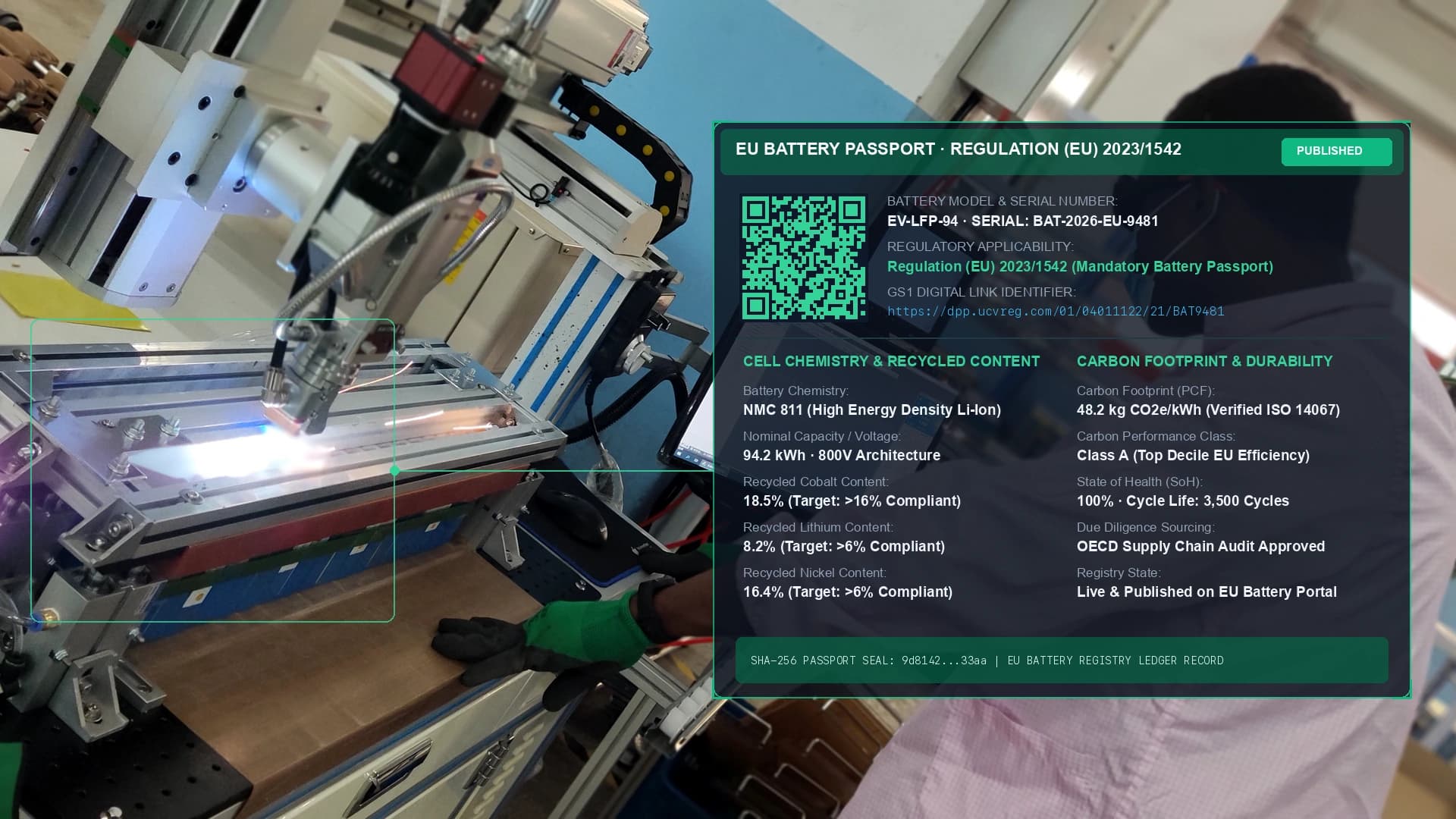

Supply-chain due diligence and carbon-footprint information
Battery compliance information often comes from outside the organisation: cell and module suppliers, material and component suppliers, manufacturing locations, testing laboratories, carbon-footprint specialists, certification and conformity-assessment bodies, and recycling and second-life operators.
This information may arrive as technical files, declarations, certificates, test results, spreadsheets and supplier questionnaires. Without a controlled process, it can become difficult to determine which supplier provided the information, which battery or product it relates to, whether the document is still valid, who reviewed it, whether it was approved and which product version it supports.
UCVreg helps organisations connect these sources to the relevant battery, product version, batch, lot or serial number.
UCVreg does not independently calculate or certify a carbon footprint, approve a supplier or provide legal advice. It provides a controlled system for managing the information, evidence, reviews and approvals supplied by the responsible teams and specialists.
Battery Passport readiness by business type
Battery pack assemblers: pack assemblers may combine cells, modules, software, enclosures and other components from several suppliers. They need to connect supplier information to the final pack record and understand which evidence supports each component, configuration and production batch. UCVreg helps organise these records and maintain the relationship between supplier information and the finished battery pack.
Electric-vehicle manufacturers: EV manufacturers may need to manage battery information alongside vehicle, model, component and lifecycle records. UCVreg helps connect vehicle and battery information to the relevant supplier, pack, product and production records. This can support EV battery passport readiness and broader battery compliance for OEMs.
LMT and micromobility companies: e-bike, e-scooter and similar light means of transport businesses may need to manage battery information across product models, battery suppliers and production records. UCVreg helps organise the information behind the battery and its relationship to the finished product, supporting LMT battery passport preparation and supplier coordination.
BESS and industrial-storage companies: stationary storage and industrial battery operators may manage systems containing batteries, modules, inverters, controls and other components. UCVreg helps bring together the relevant product, supplier, system and lifecycle information needed for a controlled compliance record for BESS, industrial energy storage and other relevant industrial battery applications.
Private-label brands and importers: a business may sell a battery under its own brand while relying on another company for manufacturing. That business may need to obtain, review and retain information from the manufacturer and other suppliers. UCVreg helps organise the information and approval trail. It does not independently determine which legal role applies to the organisation.
Repair, repurposing and second-life operators: battery records may continue to develop after first use. Repair, repurposing and second-life activities may require information about condition, assessment, changes, new use and responsible parties. UCVreg helps preserve the records connected with these activities where the relevant information is available and authorised for inclusion.
Where Batteries compliance data breaks and how UCVreg supports readiness
Battery product and supplier records
Battery companies receive information from different cell, module, component and material suppliers: one sends a technical declaration, another a certificate, another a spreadsheet or test report. Without a structured process, it is difficult to connect each piece of evidence to the correct battery model, batch, lot or pack, which complicates EV battery passport, industrial battery, BESS and OEM battery compliance and supply-chain traceability.
UCVreg structures product and supplier information in a connected record. Supporting documents and evidence can be linked to the relevant battery, module, pack, supplier, batch, lot and product version, making it easier to identify where information came from and which product it supports.
71 mapped Battery Passport data points
Battery Passport readiness involves multiple information categories. A company may have the technical specification but still lack supplier evidence, carbon-footprint information, recycled-content documentation, conformity records or approved lifecycle data, often spread across different files and business systems.
UCVreg’s mapped Battery Passport schema contains 71 data points covering battery identification, technical characteristics, cells and modules, suppliers and production, carbon footprint, recycled content, due diligence, performance, lifecycle records, and supporting evidence and approvals. The 71-point structure is UCVreg’s mapped compliance data model. It is not presented as one universal legal field count for every battery.
Version history and product changes
Battery products change over time: a cell supplier, chemistry, pack design, manufacturing site, software version or production process may change. If earlier information is overwritten, it becomes difficult to show which battery version was supplied, which supplier information and conformity documents applied, what was approved and when a change took effect.
UCVreg preserves approved versions and records important changes over time. Organisations keep a traceable history of what was submitted, what was reviewed, who approved it, which product version it applied to, what changed later and which evidence supported the record.
Controlled access and lifecycle information
Public product information, supplier evidence, technical details, repair information and authority-level records may not be appropriate for the same audience. Battery information may also need to remain available when a product is repaired, repurposed, remanufactured or recycled.
UCVreg supports controlled access to relevant battery records and evidence, so organisations can structure information for appropriate audiences while controlling who can view, contribute to or approve each record. Access rules and legal responsibilities must be configured according to the organisation’s specific requirements.
Regulatory facts
Relevant LMT and EV batteries, and industrial batteries above 2 kWh, require a battery passport under the Battery Regulation from the cited date.
18 February 2027
Citation: Regulation (EU) 2023/1542 Article 77
Sector questions
What information and evidence should teams prepare?
Prepare the product, supplier and lifecycle information needed for EU Battery Passport readiness. Relevant LMT and EV batteries, and industrial batteries above 2 kWh, require a battery passport under the Battery Regulation from the cited date. (18 February 2027).
Which products and organisational roles should teams check for scope?
The Battery Passport scope includes relevant electric-vehicle batteries and light means of transport batteries without a capacity threshold, plus industrial batteries above 2 kWh. Teams must also confirm the battery category, product, market activity and organisation’s role.
How should the relevant data and evidence be managed?
UCVreg structures product and supplier information in a connected record. Supporting documents and evidence can be linked to the relevant battery, module, pack, supplier, batch, lot and product version, making it easier to identify where information came from and which product it supports.
Where should teams begin?
Battery Passport readiness depends on more than the final battery specification. It requires a controlled way to organise product information, supplier evidence, approvals and lifecycle records. UCVreg helps battery businesses prepare and manage the information behind EU Battery Passport readiness.
Scope
8507 108507 60 008507 80 008507 90From 18 February 2027, the Battery Passport requirement applies to relevant electric-vehicle batteries, light means of transport batteries and industrial batteries above 2 kWh. The applicable requirements depend on the battery category, product, market activity and organisation’s role.
Regulation (EU) 2023/1542 concerns batteries and waste batteries and includes requirements relating to sustainability, safety, labelling, supply-chain information, carbon footprint, performance and end-of-life management.
Not every battery is subject to the same Battery Passport requirement on the same date. A battery may still be subject to other obligations even when the Battery Passport requirement does not apply to it. Organisations should assess the relevant battery category, product and market role before deciding what information must be prepared.
Battery Passport readiness requires more than producing a QR code or storing one technical document. It requires a controlled way to organise product information, supplier evidence, technical records, carbon-footprint information, due-diligence information, approvals and lifecycle records. UCVreg provides data and workflow infrastructure. It does not replace legal advice, testing, certification or conformity assessment.
For the product-record foundation behind battery records, see UCVreg’s Digital Product Passport infrastructure.
This page provides general information and is not legal advice. Battery companies should assess the latest official requirements for their specific product, category and market role.