
EUDR Timber Traceability and Compliance Data
Connect forest origin, wood species, harvest information, suppliers, product lots and legality evidence for EUDR due diligence.
UCVreg helps forest operators, timber processors, manufacturers, importers and downstream businesses structure the data needed to demonstrate where wood originated, how it moved through the supply chain and which evidence supports its deforestation-free and legal status.
The EU regulatory landscape for Timber
Timber scope and application dates
The EU Deforestation Regulation covers wood and specified derived products listed under Combined Nomenclature and Harmonised System codes in the operative Annex I.
Products in scope include many forms of timber, wood-based panels, pulp, paper, furniture and other wooden articles. Coverage must be checked against the applicable Annex I code rather than assumed from a product’s commercial name or the fact that it contains wood.
EUDR applies from 30 December 2026 to large and medium-sized operators and to micro and small operators already covered by the former EU Timber Regulation. It applies from 30 June 2027 to most other micro and small operators.
Special transitional provisions apply to older timber stocks. The applicable regime can depend on when the timber was harvested or produced, when it was placed on the market and whether the product was covered by the former EU Timber Regulation. Businesses holding timber harvested before 29 June 2023, or products manufactured from older timber, should assess those dates against the specific EUTR-to-EUDR transition rules.
Deforestation-free and forest-degradation requirements
Wood products must not originate from land subject to deforestation after 31 December 2020. For timber, operators must also establish that the wood was harvested without inducing forest degradation as defined by the Regulation. This is a separate timber-specific element of the EUDR deforestation-free test.
A natural disturbance does not, by itself, establish either compliance or non-compliance. Commission guidance recognises that forest land can remain classified as forest where it is temporarily unstocked because of a forest-management practice or natural disaster and is expected to regenerate. Operators should document the previous forest type, disturbance, harvesting activity and expected regeneration so they can demonstrate that the harvesting itself did not induce forest degradation.
Relevant products must also have been produced in accordance with the relevant legislation of the country of production.
EUDR Geolocation & Due Diligence Pipeline
End-to-end verified workflow from supplier ingestion to EU market clearance
Plot Geolocation
GPS & PolygonsIngest polygon coordinates for farm parcels (>4 ha) and point coordinates (<4 ha) across supply cooperatives.
Deforestation Check
Copernicus SatelliteAutomated spatial overlay against 31 Dec 2020 forest baselines, proving zero deforestation and statutory legality.
DDS Statement
TRACES-NT RegistrySubmit verified Due Diligence Statements to the EU TRACES-NT platform and generate immutable reference numbers.
Customs Clearance
Market ReleaseTransmit verifiable DDS reference codes downstream to customs authorities, port logistics, and EU buyers.
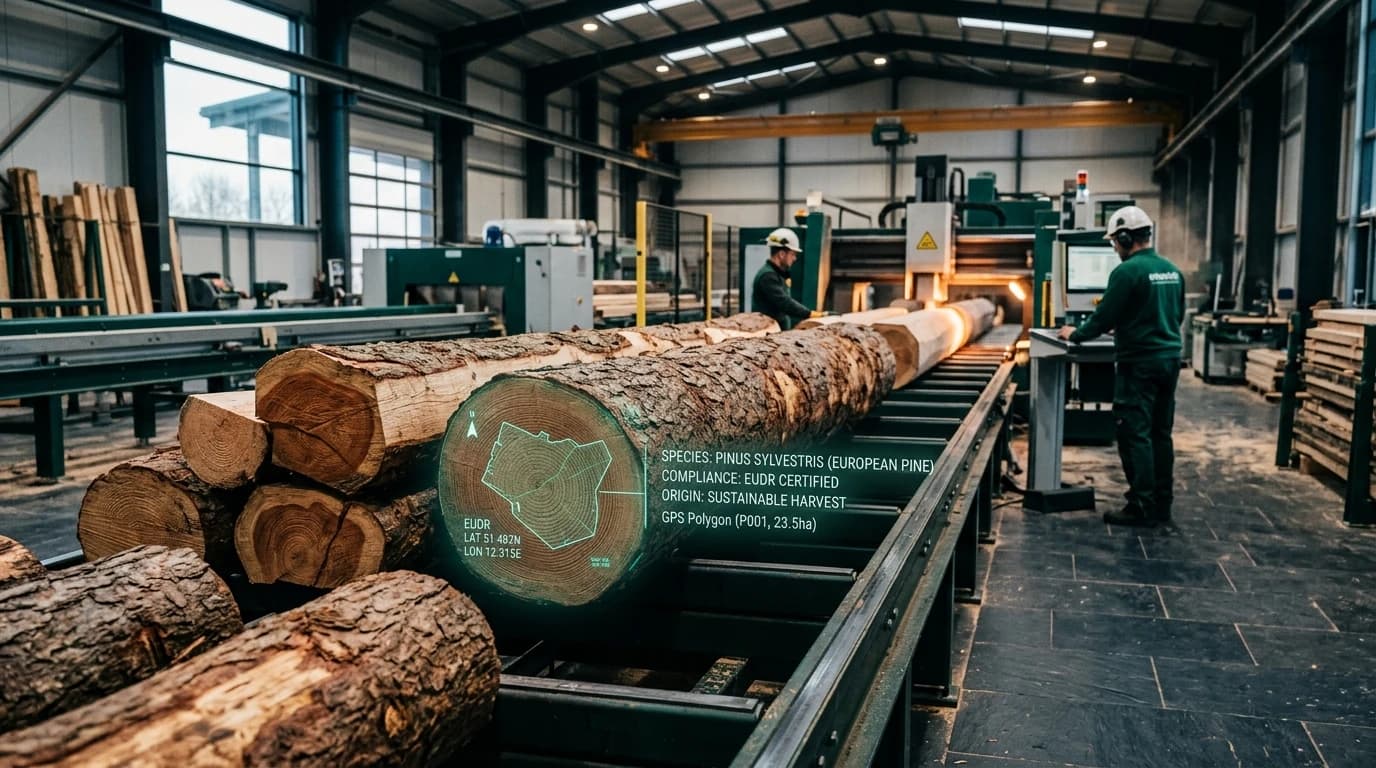

Plot, species and legality information
Operators responsible for due diligence must collect the information required under Article 9, including product, quantity, country-of-production and supply-chain information.
For wood products, records must include the common name and full scientific name of the relevant tree species. Operators must obtain the geolocation of all plots from which the wood originated and the relevant production or harvest date or time range.
They must also retain sufficiently conclusive and verifiable evidence that the timber is deforestation-free and legally produced.
Simplified roles and reporting
The 2025 amendment and the Commission’s 2026 implementation package simplified responsibilities across the supply chain.
Operators remain responsible for conducting the applicable due diligence and submitting a due diligence statement before placing relevant timber products on the EU market or exporting them.
Qualifying micro and small primary operators established in low-risk countries may submit a one-time simplified declaration instead of a due diligence statement. They must still collect the required information and maintain an appropriate compliance framework. Additional action may be required where they become aware of information indicating a non-negligible risk.
Downstream operators and traders do not generally repeat the upstream due-diligence exercise or submit a new due diligence statement. They must retain required supplier, customer and declaration-reference information and provide it to competent authorities when requested. Additional notification or verification requirements apply where new information or substantiated concerns indicate possible non-compliance. Non-SME downstream operators and traders also have Information System registration requirements.
The precise responsibility depends on the product, activity, organisation size and position in the supply chain.
Where Timber compliance data breaks and how UCVreg supports readiness
Connect forest origins to timber products
Timber products may pass through forest owners, harvesting operators, sawmills, processors, traders and manufacturers before reaching the EU market. Plot, species and harvest information can become separated from the physical timber during these transfers.
Connect supplied information concerning forest plots, tree species, harvesting activities, timber lots, suppliers, processors and production facilities within a reconstructable evidence chain.
Preserve traceability through processing
Timber from multiple plots may be aggregated or transformed into panels, pulp, paper, furniture and composite wood products. Every relevant source must remain identifiable even when the original material changes form.
Maintain relationships between source plots, input lots, processing batches and finished products while retaining the relevant species, supplier and production information.
Connect legality claims to evidence
Harvesting rights, permits, forest-management records, transport documents and supplier declarations are often stored across disconnected systems and organisations.
Bring supplier evidence, geolocation files and supporting documents into controlled regulatory records. Source-linked extraction retains the relevant page and supporting text for human review and approval.
Preserve approved evidence states
Origin information, supplier records and supporting evidence may change or be replaced as timber moves through the supply chain.
Maintain versioned evidence, controlled access, audit histories and SHA-256 integrity verification so teams can identify what information supported an internally approved record at a particular time. EUDR-specific risk documentation, due diligence statement packaging and inspection reconstruction remain in development.
Regulatory facts
General operators must complete EUDR due diligence from the cited effective date.
30 December 2026
Citation: Regulation (EU) 2025/2650 amending Regulation (EU) 2023/1115
Micro and small operators in products that were not previously in EUTR follow the later cited date. Small and micro operators in previously-EUTR products remain on the general deadline.
30 June 2027
Citation: Regulation (EU) 2025/2650 Art. 38(2) (non-EUTR micro/small operators)
Sector questions
What information and evidence should teams prepare?
Connect forest origin, wood species, harvest information, suppliers, product lots and legality evidence for EUDR due diligence. General operators must complete EUDR due diligence from the cited effective date. (30 December 2026). Micro and small operators in products that were not previously in EUTR follow the later cited date. Small and micro operators in previously-EUTR products remain on the general deadline. (30 June 2027).
Which products and organisational roles should teams check for scope?
Relevant wood products include many forms of timber, wood-based panels, pulp, paper, furniture and other wooden articles. Coverage must be checked against the applicable CN/HS code. Duties then depend on the product, market activity, organisation size and whether the organisation acts as an operator, trader or downstream participant.
How should the relevant data and evidence be managed?
Connect supplied information concerning forest plots, tree species, harvesting activities, timber lots, suppliers, processors and production facilities within a reconstructable evidence chain.
Where should teams begin?
Bring forest origins, species, suppliers, product lots and legality evidence into one governed compliance record.
Follow a furniture shipment through material lots, wood sources and supplier evidence.