
Food and Agriculture EU Compliance and Traceability
Prepare agricultural commodity, farm, processor, packaging and supply-chain data for EUDR due diligence, food safety rules and evolving sustainability requirements.
UCVreg helps agricultural producers, commodity traders, food processors, importers and retailers structure compliance information, verify zero-deforestation evidence and maintain auditable regulatory records.
The EU regulatory landscape for Food & agriculture
EU Deforestation Regulation (EUDR, Regulation (EU) 2023/1115)
Covers seven key commodities and their derived products: cattle, cocoa, coffee, oil palm, rubber, soya and wood. Relevant products placed on the EU market or exported from the EU must be deforestation-free (produced on land not subject to deforestation after 31 December 2020), produced legally, and supported by an electronic Due Diligence Statement (DDS).
Most obligations apply from 30 December 2026 for large and medium operators, and 30 June 2027 for micro and small enterprises.
Packaging and Packaging Waste Regulation (PPWR) in Food
Food and beverage packaging must comply with the PPWR, requiring design for recycling, minimum post-consumer recycled plastic thresholds, restrictions on PFAS in food contact materials, and standardized sorting instructions.
Food enterprises must coordinate agricultural commodity origin records alongside packaging material compliance declarations.
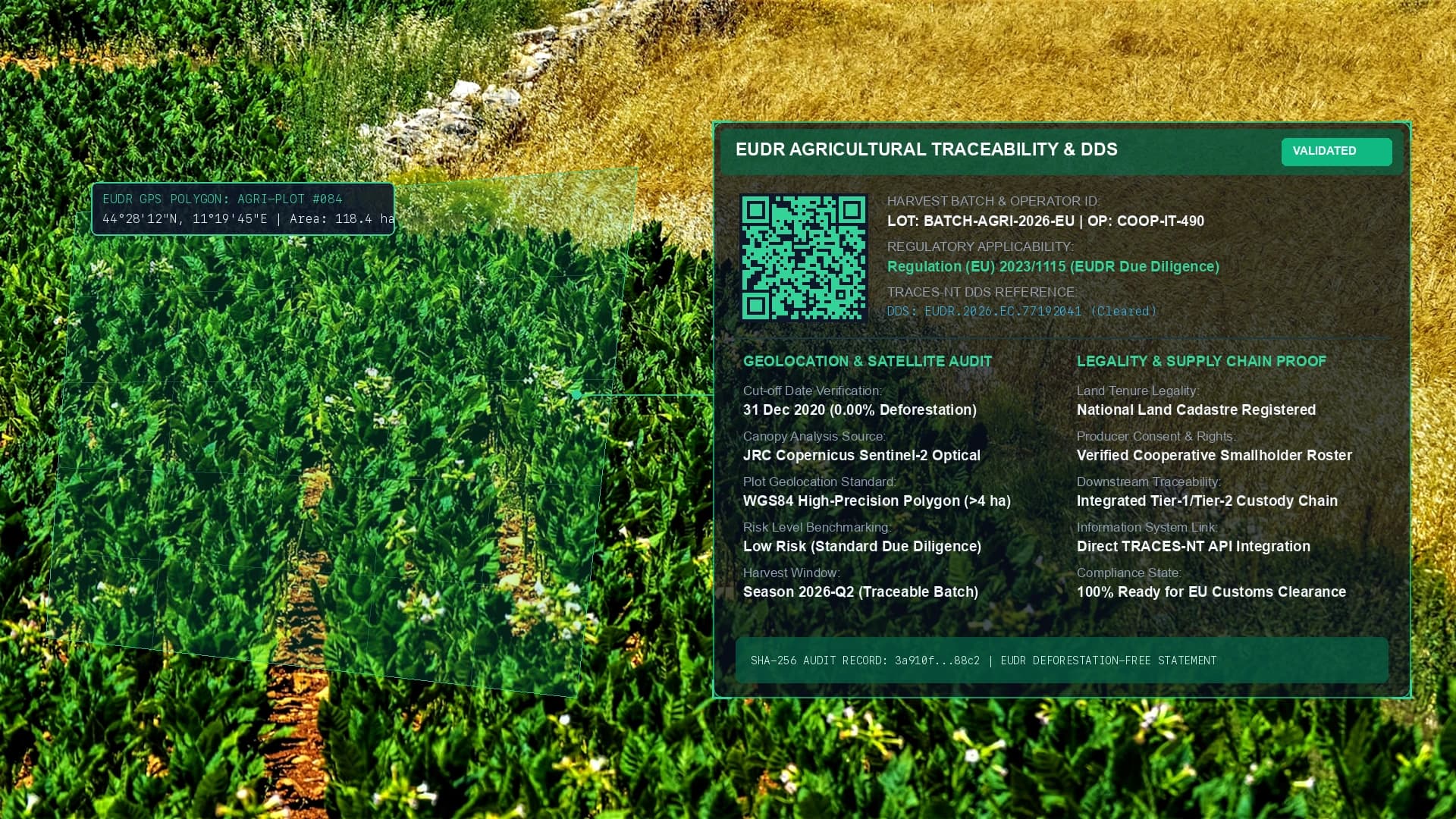
EUDR Geolocation & Due Diligence Pipeline
End-to-end verified workflow from supplier ingestion to EU market clearance
Plot Geolocation
GPS & PolygonsIngest polygon coordinates for farm parcels (>4 ha) and point coordinates (<4 ha) across supply cooperatives.
Deforestation Check
Copernicus SatelliteAutomated spatial overlay against 31 Dec 2020 forest baselines, proving zero deforestation and statutory legality.
DDS Statement
TRACES-NT RegistrySubmit verified Due Diligence Statements to the EU TRACES-NT platform and generate immutable reference numbers.
Customs Clearance
Market ReleaseTransmit verifiable DDS reference codes downstream to customs authorities, port logistics, and EU buyers.

Where Food & agriculture compliance data breaks and how UCVreg supports readiness
Ingest geospatial coordinates across multi-origin supply sheds
Agricultural products are sourced from millions of smallholders across diverse geographies with varying digital infrastructure.
Support bulk shapefile, GeoJSON and mobile field app polygon ingestion with automated spatial validation.
Verify zero deforestation against 2020 satellite baselines
Confirming zero forest loss after December 2020 requires automated satellite screening and auditable canopy change proof.
Automate spatial intersection against Copernicus forest cover baselines to generate timestamped risk assessments.
Track batch custody through food manufacturing
Agricultural ingredients from compliant and non-compliant plots must not be mixed in bulk storage silos or processing lines.
Maintain batch segregation and lot-level mass-balance ledgers connecting final packaged SKUs to certified farm plots.
Automate TRACES-NT Due Diligence Statement filings
High-frequency food shipments require continuous submission of complex DDS dossiers to the EU TRACES-NT portal.
Streamline DDS compilation and automated submission via direct API integrations with full reference number tracking.
Regulatory facts
General operators must complete EUDR due diligence from the cited effective date.
30 December 2026
Citation: Regulation (EU) 2025/2650 amending Regulation (EU) 2023/1115
Micro and small operators in products that were not previously in EUTR follow the later cited date. Small and micro operators in previously-EUTR products remain on the general deadline.
30 June 2027
Citation: Regulation (EU) 2025/2650 Art. 38(2) (non-EUTR micro/small operators)
Sector questions
What information and evidence should teams prepare?
Prepare agricultural commodity, farm, processor, packaging and supply-chain data for EUDR due diligence, food safety rules and evolving sustainability requirements. General operators must complete EUDR due diligence from the cited effective date. (30 December 2026). Micro and small operators in products that were not previously in EUTR follow the later cited date. Small and micro operators in previously-EUTR products remain on the general deadline. (30 June 2027).
Which products and organisational roles should teams check for scope?
Covers cattle/beef, cocoa/chocolate, coffee, palm oil, soya beans/meal, and derived food preparations. Teams should also confirm the organisation’s role and the applicable product category before treating an item as in scope.
How should the relevant data and evidence be managed?
Support bulk shapefile, GeoJSON and mobile field app polygon ingestion with automated spatial validation.
Where should teams begin?
Build a controlled foundation for farm plot polygons, batch traceability, satellite deforestation checks and TRACES-NT DDS submissions.
Scope
01020201090112011511180118062304Covers cattle/beef, cocoa/chocolate, coffee, palm oil, soya beans/meal, and derived food preparations.
Mandatory due diligence applies from 30 December 2026 for large operators and 30 June 2027 for micro/small enterprises.
Explore how UCVreg manages multi-commodity agricultural farm mapping and TRACES-NT filing on our food and agriculture EUDR platform guide.