EUDR Soya Traceability and Compliance Data
Connect soya farm plots, rural storage facilities, grain elevators, crushing plants, feed compounders, supplier transactions and legality evidence for EUDR due diligence.
UCVreg helps soya importers, agricultural traders, feed manufacturers, livestock producers and food brands structure deforestation-free supply chain records.
The EU regulatory landscape for Soya
Soya Scope and Application Dates
The EU Deforestation Regulation covers soya beans and specified derived products listed under EUDR Annex I, including whole soya beans (seed, food and feed grade), soya bean flour and meal, crude and refined soya bean oil, and soya bean oilcake.
Under the EUDR, relevant soya commodities placed on the EU market or exported from the EU must be deforestation-free (grown on land not subject to deforestation after 31 December 2020), produced legally, and supported by an official Due Diligence Statement.
Most EUDR obligations apply from 30 December 2026 for large and medium operators. For undertakings established as micro or small enterprises by 31 December 2020, obligations apply from 30 June 2027.
Plot Geolocation and Grain Traceability
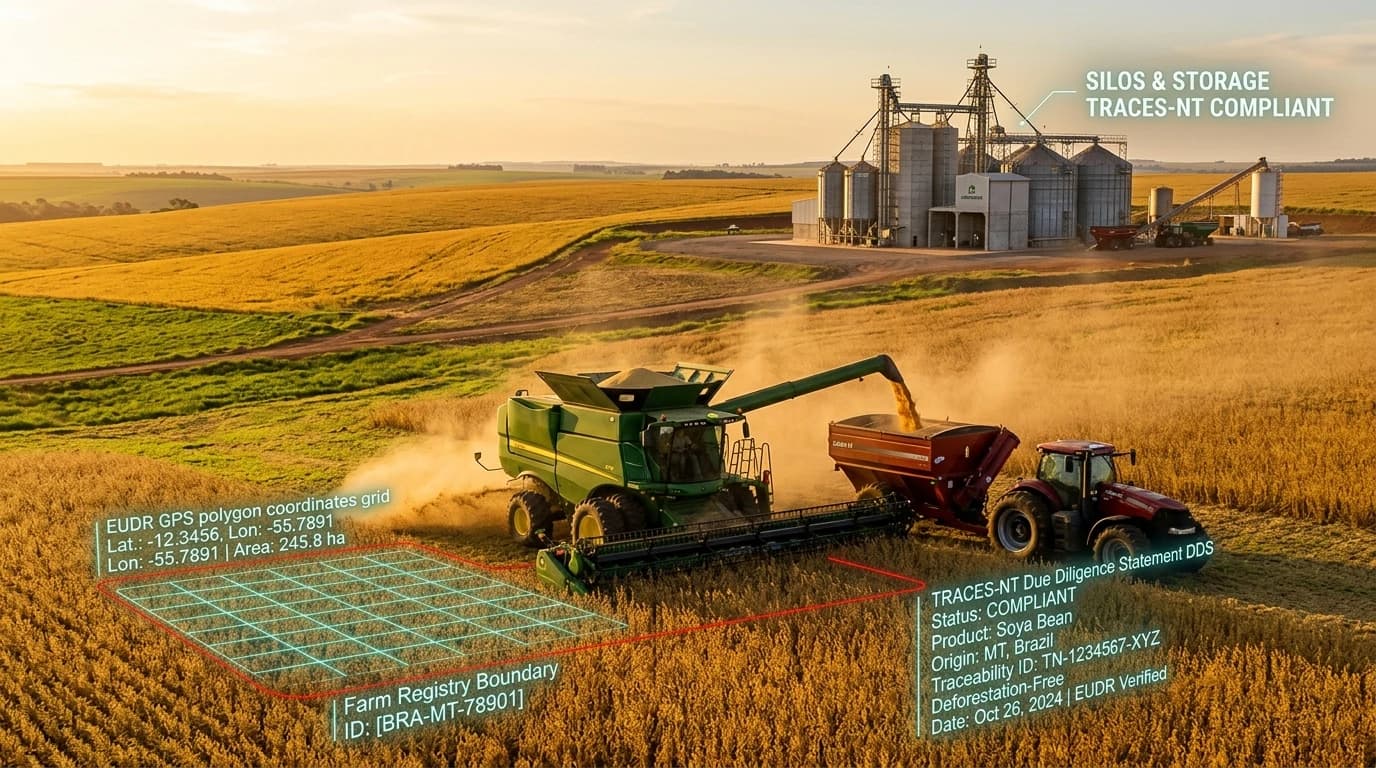
Operators must capture GPS polygon coordinates for all farm parcels where soya beans were harvested:
Because soya is commonly commingled in large country elevators and bulk panamax vessels, traceability systems must preserve linkage to all contributing farm plots.
- ✓GPS polygon coordinates for all production plots 4 ha and above (Glycine max)
- ✓Single point coordinates for smallholder parcels under 4 ha
- ✓Harvest window dates and production period records
- ✓Environmental land registry records (e.g. Brazil CAR registry, rural land deeds)
- ✓Compliance with local agricultural, environmental and labor laws
- ✓Electronic Due Diligence Statements filed in TRACES-NT
EUDR Geolocation & Due Diligence Pipeline
End-to-end verified workflow from supplier ingestion to EU market clearance
Plot Geolocation
GPS & PolygonsIngest polygon coordinates for farm parcels (>4 ha) and point coordinates (<4 ha) across supply cooperatives.
Deforestation Check
Copernicus SatelliteAutomated spatial overlay against 31 Dec 2020 forest baselines, proving zero deforestation and statutory legality.
DDS Statement
TRACES-NT RegistrySubmit verified Due Diligence Statements to the EU TRACES-NT platform and generate immutable reference numbers.
Customs Clearance
Market ReleaseTransmit verifiable DDS reference codes downstream to customs authorities, port logistics, and EU buyers.

Where Soya compliance data breaks and how UCVreg supports readiness
Trace bulk commingled grain shipments
Soya beans from hundreds of farms are combined at country silos, river barges, export elevators and ocean bulk freighters.
Connect cargo batch ledgers to all contributing farm plot polygons with automated mass-balance and segregation tracking.
Verify zero deforestation across large agricultural landscapes
Monitoring deforestation and biome conversion across the Amazon and Cerrado requires precise multi-year satellite validation.
Run automated spatial overlay against Copernicus satellite tree cover baselines to detect post-2020 deforestation.
Collate national land registry and legal compliance documents
Verifying statutory production legality requires cross-referencing rural environmental registries (CAR), land titles and labor audits.
Store and index official farm registration records, environmental permits and supplier declarations in a tamper-evident ledger.
Streamline TRACES-NT Due Diligence Statement submissions
Large soya vessels contain thousands of farm polygons that must be compiled into compliant XML/JSON payloads for TRACES-NT.
Package validated batch data and plot geometries into EUDR-compliant payloads for seamless API transmission and DDS filing.
Regulatory facts
General operators must complete EUDR due diligence from the cited effective date.
30 December 2026
Citation: Regulation (EU) 2025/2650 amending Regulation (EU) 2023/1115
Micro and small operators in products that were not previously in EUTR follow the later cited date. Small and micro operators in previously-EUTR products remain on the general deadline.
30 June 2027
Citation: Regulation (EU) 2025/2650 Art. 38(2) (non-EUTR micro/small operators)
Sector questions
What information and evidence should teams prepare?
Connect soya farm plots, rural storage facilities, grain elevators, crushing plants, feed compounders, supplier transactions and legality evidence for EUDR due diligence. General operators must complete EUDR due diligence from the cited effective date. (30 December 2026). Micro and small operators in products that were not previously in EUTR follow the later cited date. Small and micro operators in previously-EUTR products remain on the general deadline. (30 June 2027).
Which products and organisational roles should teams check for scope?
Covers whole soya beans, soya bean flour, crude and refined soya bean oil, and solid soya bean oilcake/meal. Coverage must be checked against the applicable CN/HS code. Duties then depend on the product, market activity, organisation size and whether the organisation acts as an operator, trader or downstream participant.
How should the relevant data and evidence be managed?
Connect cargo batch ledgers to all contributing farm plot polygons with automated mass-balance and segregation tracking.
Where should teams begin?
Build a controlled foundation for farm registry polygons, grain elevator batch tracking, satellite deforestation checks and TRACES-NT filings.
Scope
1201 10 001201 90 001208 10 001507 101507 902304 00 00Covers whole soya beans, soya bean flour, crude and refined soya bean oil, and solid soya bean oilcake/meal.
Mandatory due diligence applies from 30 December 2026 for large operators and 30 June 2027 for micro and small enterprises.
Learn how UCVreg verifies grain elevator batches and farm polygon registries in our soya bean EUDR compliance guide.