
EUDR Coffee Traceability and Compliance Data
Connect coffee farm origin, producer cooperatives, washing stations, export lots, supplier transactions and legality evidence for EUDR due diligence.
UCVreg helps green-coffee importers, traders, specialty roasters, processors and retailers structure the data needed to demonstrate deforestation-free coffee supply chains.
The EU regulatory landscape for Coffee
Coffee Scope and Application Dates
The EU Deforestation Regulation covers coffee and specified derived products classified under Combined Nomenclature heading 0901, including unroasted green coffee, roasted coffee, decaffeinated coffee, and coffee husks and skins.
Relevant coffee products placed on the EU market must be deforestation-free (produced on land not subject to deforestation after 31 December 2020), produced in accordance with local legislation, and covered by an official Due Diligence Statement.
Most EUDR obligations apply from 30 December 2026 for large and medium operators. For undertakings established as micro or small enterprises by 31 December 2020, obligations apply from 30 June 2027.
Plot Geolocation, Altitude and Species Identification
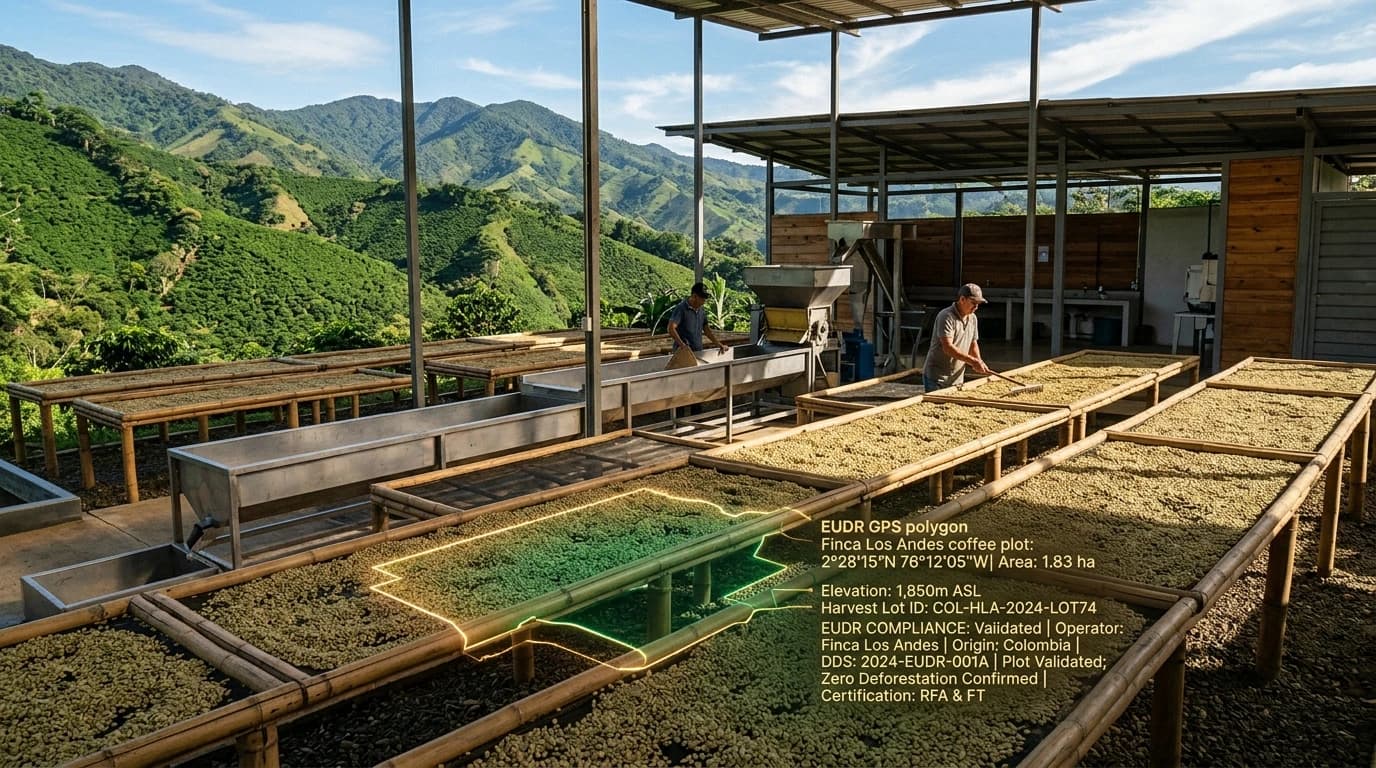
For all coffee shipments, operators must capture geolocation data for the exact plots of land where the coffee cherries were grown:
Soluble coffee extracts and instant coffee preparations (HS 2101) are currently excluded from EUDR Annex I, but unroasted and roasted green bean inputs remain strictly regulated.
- ✓GPS polygon coordinates for plots 4 ha and above, point coordinates for smaller plots
- ✓Botanical species identification (Coffea arabica, Coffea canephora/robusta)
- ✓Harvest window dates and production period records
- ✓Producer country statutory compliance (land tenure, environmental permits, labor rights)
- ✓Unbroken chain of custody through wet mills, dry mills and containerized export lots
EUDR Geolocation & Due Diligence Pipeline
End-to-end verified workflow from supplier ingestion to EU market clearance
Plot Geolocation
GPS & PolygonsIngest polygon coordinates for farm parcels (>4 ha) and point coordinates (<4 ha) across supply cooperatives.
Deforestation Check
Copernicus SatelliteAutomated spatial overlay against 31 Dec 2020 forest baselines, proving zero deforestation and statutory legality.
DDS Statement
TRACES-NT RegistrySubmit verified Due Diligence Statements to the EU TRACES-NT platform and generate immutable reference numbers.
Customs Clearance
Market ReleaseTransmit verifiable DDS reference codes downstream to customs authorities, port logistics, and EU buyers.

Where Coffee compliance data breaks and how UCVreg supports readiness
Map smallholder farm plots across remote mountain origins
Specialty coffee originates from hundreds of thousands of micro-producers on steep terrain across East Africa, Central America and the Andes.
Collect and validate geospatial polygon boundaries with automated elevation and boundary topology checks.
Verify zero deforestation after December 2020
Distinguishing between shade-grown agroforestry coffee canopies and natural primary forest requires high-resolution satellite imagery.
Perform automated spatial overlay against Copernicus baseline maps to detect forest conversion with auditable evidence reports.
Track containerized batches through washing and milling
Coffee cherries from multiple farms are combined at central washing stations and dry hulling mills before container loading.
Maintain batch segregation and lot-level traceability ledgers connecting farm origin plots to export shipping bills.
Generate verified TRACES-NT DDS reference numbers
Downstream roasters require verified DDS reference numbers before customs release and retail distribution in the EU.
Streamline Due Diligence Statement compilation and electronic transmission via the EU TRACES-NT Gateway.
Regulatory facts
General operators must complete EUDR due diligence from the cited effective date.
30 December 2026
Citation: Regulation (EU) 2025/2650 amending Regulation (EU) 2023/1115
Annex I additions for soluble coffee and certain refined palm-oil fractions take effect on the cited date, subject to scrutiny.
30 December 2027
Citation: Commission Delegated Regulation amending Annex I (Soluble coffee, refined palm oil fractions)
Sector questions
What information and evidence should teams prepare?
Connect coffee farm origin, producer cooperatives, washing stations, export lots, supplier transactions and legality evidence for EUDR due diligence. General operators must complete EUDR due diligence from the cited effective date. (30 December 2026). Annex I additions for soluble coffee and certain refined palm-oil fractions take effect on the cited date, subject to scrutiny. (30 December 2027).
Which products and organisational roles should teams check for scope?
Covers green coffee beans, roasted coffee, decaffeinated coffee, and coffee husks and skins under CN 0901. Coverage must be checked against the applicable CN/HS code. Duties then depend on the product, market activity, organisation size and whether the organisation acts as an operator, trader or downstream participant.
How should the relevant data and evidence be managed?
Collect and validate geospatial polygon boundaries with automated elevation and boundary topology checks.
Where should teams begin?
Build a controlled foundation for coffee farm polygons, washing station lot ledgers, deforestation checks and TRACES-NT DDS filings.
Scope
0901 11 000901 12 000901 21 000901 22 000901 90 100901 90 90Covers green coffee beans, roasted coffee, decaffeinated coffee, and coffee husks and skins under CN 0901.
Excludes soluble coffee extracts and instant coffee preparations under HS 2101, but unroasted inputs remain strictly regulated.
To learn how UCVreg manages smallholder coffee plot mapping and container batch tracking, consult our coffee EUDR compliance workflow.