
Préparation ESPR et données d’étiquetage des pneumatiques
Préparez les données relatives aux produits, performances, matériaux et chaînes d’approvisionnement de pneumatiques en vue des exigences européennes d’écoconception à venir et des passeports numériques de produits.
UCVreg helps tyre manufacturers, importers, private-label operators and automotive suppliers structure compliance information, connect claims to evidence and maintain verifiable regulatory records as EU requirements develop.
Le cadre réglementaire de l’UE pour Pneumatiques
ESPR Tyre Requirements
The Ecodesign for Sustainable Products Regulation establishes the framework for introducing product-specific sustainability, performance and information requirements across the EU market.
Tyres are a priority product group in the ESPR Working Plan 2025–2030. The Commission’s current indicative timeline places adoption of the tyre-specific delegated act in Q3–Q4 2027.
A Commission-commissioned preparatory study is assessing possible ecodesign measures, including how future rules can complement existing tyre legislation. The study is expected to conclude in August 2027.
The delegated act will determine the tyre categories covered, applicable requirements and final application date. Following adoption, economic operators are expected to receive a transition period of at least 18 months.
Tyre Digital Product Passport
A future tyre delegated act is expected to introduce tyre-specific Digital Product Passport requirements.
The tyre DPP could provide controlled access to information concerning:
These categories reflect current regulatory and preparatory work. The exact mandatory fields, identification level, data carrier and access permissions have not yet been finalised.
The EU DPP Registry became operational on 20 July 2026, but this does not make Digital Product Passports mandatory for tyres today.
- ✓Tyre and model identification
- ✓Manufacturer and responsible economic operator
- ✓Dimensions and product characteristics
- ✓Material composition and supporting evidence
- ✓Sustainability and environmental-performance information
- ✓Durability, mileage or abrasion information
- ✓Recycled content, where required
- ✓Retreading, reuse and end-of-life information
Parcours ESPR du passeport numérique de produit
Parcours vérifié de bout en bout, de l’intégration des données fournisseur à la mise sur le marché de l’UE
Intégration des nomenclatures et matériaux
Données de chaîne d’approvisionnementCollectez les compositions de fibres et matériaux à plusieurs niveaux, les taux de contenu recyclé et les déclarations d’essais fournisseurs.
Validation de l’écoconception
ESPR et durabilitéVérifiez la durabilité du produit, les seuils chimiques SVHC, les limites de microplastiques et les règles de l’article 23 relatives aux invendus.
Enregistrement au registre DPP
Passerelle décentraliséeEnregistrez les passeports produits cryptographiques sur la passerelle DPP de l’UE avec des droits d’accès fondés sur les rôles.
Vérification du support de données
GS1 QR / matrice 2DApposez des supports de données 2D persistants, accessibles aux consommateurs, réparateurs professionnels, recycleurs et autorités douanières.
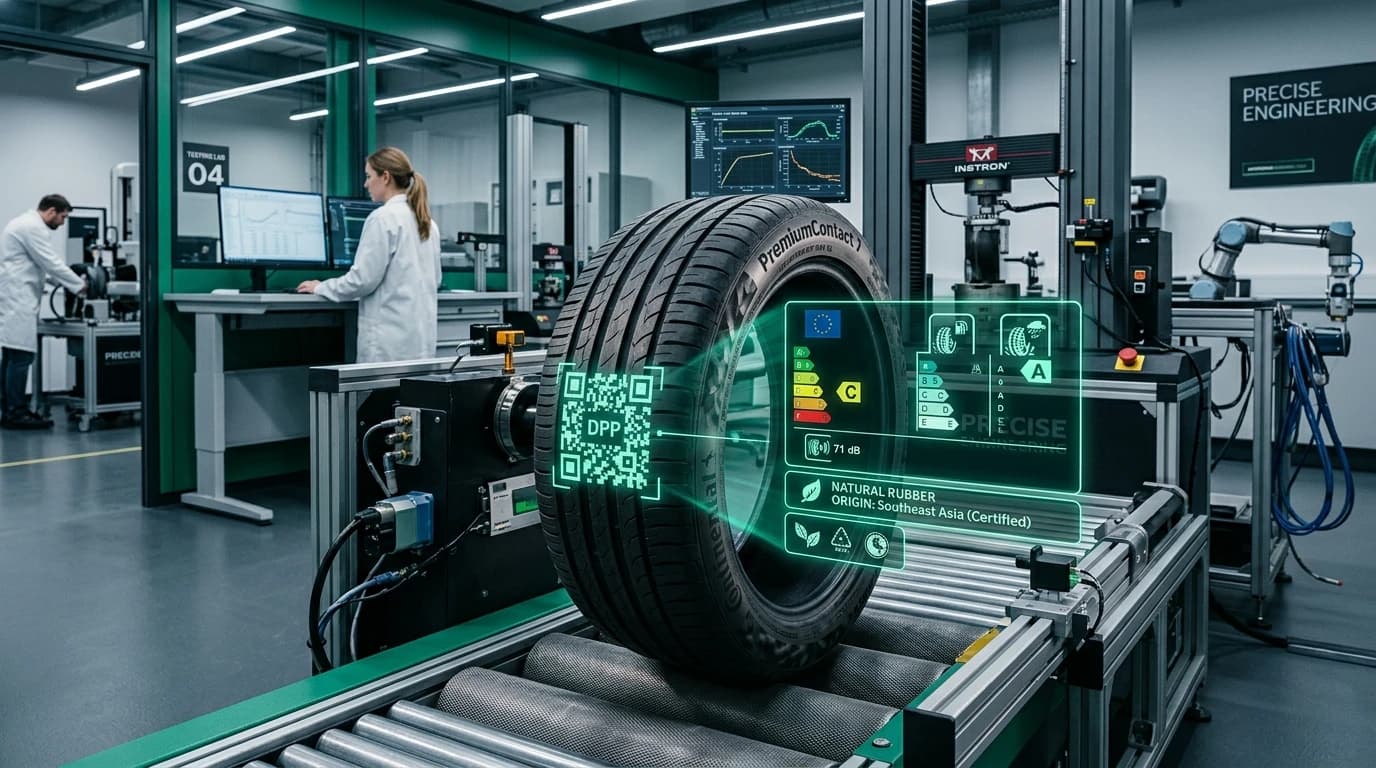

EU Tyre Labelling and EPREL
Regulation (EU) 2020/740 already establishes information requirements for tyre categories within its scope, including passenger-car tyres, light-commercial-vehicle tyres and heavy-duty-vehicle tyres.
The current EU tyre label communicates:
Tyre suppliers must register tyre types covered by the regulation in the European Product Registry for Energy Labelling before placing them on the EU market. The QR code on the tyre label provides access to the corresponding EPREL information.
EPREL registration and the future tyre DPP should not currently be presented as the same requirement. Their relationship will depend on the final tyre delegated act and supporting EU measures.
- ✓Rolling-resistance class from A to E
- ✓Wet-grip class from A to E
- ✓External rolling-noise value and class
- ✓External rolling-noise value in dB and class from A to C
- ✓Severe-ice performance for qualifying C1 passenger-car tyres, where applicable
EUDR and Natural Rubber
Natural rubber remains a commodity covered by the EU Deforestation Regulation. New pneumatic tyres made using relevant natural rubber remain within the EUDR product scope under the applicable Annex I customs classification.
On 13 July 2026, the Commission adopted a delegated act amending Annex I. The amendment is intended to remove retreaded tyres from scope, limit the relevant CN 4012 coverage to new rubber tyre treads, and clarify exclusions for used and second-hand products. As of August 2026, the act remains subject to European Parliament and Council scrutiny, so businesses must check the Annex I legally in force when assessing a particular tyre or tread.
For an in-scope product, the relevant economic operator must establish that it is deforestation-free, produced in accordance with the applicable legislation of the country of production and covered by the required due-diligence process. Applicability depends on the product’s customs classification, rubber composition and the organisation’s role in the supply chain.
EUDR applies from 30 December 2026 to large and medium operators and to micro and small operators already covered by the EU Timber Regulation. It applies from 30 June 2027 to other micro and small operators.
Tyre businesses should treat ESPR product information and EUDR natural-rubber due-diligence information as connected but legally distinct workstreams.
Où les données de conformité de Pneumatiques se fragmentent et comment UCVreg accompagne la préparation
Manage complex tyre models and variants
A tyre range may contain multiple dimensions, load indexes, speed ratings, performance classes and production variants supported by different technical records.
Structure tyre families, models, variants and specifications within connected regulatory records instead of managing each configuration through separate documents and spreadsheets.
Connect performance data to evidence
Tyre-label values, EPREL-related information, test reports and technical documentation may be stored across different systems and teams.
Link each recorded performance value to its supporting evidence. AI-assisted extraction retains the relevant source page and text for human review and approval before publication.
Link materials to suppliers and facilities
Natural and synthetic rubber, carbon black, steel and textile reinforcement may come from multiple suppliers and production locations.
Connect tyre records to materials, components, suppliers, facilities and supporting documents while giving authorised partners controlled access to contribute information.
Preserve changing product and lifecycle records
Product specifications, suppliers, evidence and regulatory requirements may change throughout a tyre model’s commercial life, including during retreading or other lifecycle activity.
Maintain versioned regulatory records, append-only lifecycle events and publication snapshots without overwriting previous approved states. SHA-256 fingerprints help verify whether a published record has subsequently changed.
Faits réglementaires
Les pneumatiques figurent dans le plan de travail ESPR avec une année indicative d'acte délégué.
2027
Référence: Commission Communication COM(2025) 187 final
Questions du secteur
Quelles informations et preuves les équipes doivent-elles préparer ?
Préparez les données relatives aux produits, performances, matériaux et chaînes d’approvisionnement de pneumatiques en vue des exigences européennes d’écoconception à venir et des passeports numériques de produits. Les pneumatiques figurent dans le plan de travail ESPR avec une année indicative d'acte délégué. (2027).
Quels produits et rôles organisationnels les équipes doivent-elles vérifier pour déterminer le périmètre ?
Sont concernés les pneumatiques pour voitures particulières (C1), véhicules utilitaires légers (C2), véhicules utilitaires lourds (C3), ainsi que les pneumatiques agricoles et de chantier. Les équipes doivent aussi confirmer le rôle de l’organisation et la catégorie de produit applicable avant de considérer un produit comme couvert.
Comment gérer les données et les preuves pertinentes ?
Structurez les familles, modèles, variantes et spécifications de pneumatiques dans des dossiers réglementaires reliés au lieu de gérer chaque configuration dans des documents et feuilles de calcul distincts.
Par où les équipes doivent-elles commencer ?
Établissez une base maîtrisée pour les passeports numériques de produit des pneumatiques, les preuves de performance, la traçabilité des matériaux et l’évolution des exigences ESPR.
Champ d'application
4011 10 004011 20 104011 20 904011 70 004011 80 00Covers passenger car tyres (C1), light commercial vehicle tyres (C2), heavy commercial vehicle tyres (C3), agricultural and construction tyres.
ESPR delegated act adoption targeted for Q3–Q4 2027 alongside Regulation (EU) 2020/740 and EUDR Annex I natural rubber requirements.
For a comprehensive overview of how UCVreg bridges tyre labeling, EPREL and rubber origin data, consult our guide du passeport numérique de produit pour pneumatiques.