
Where Did the EUDR Come From? Why the European Union Treats Deforestation as a Supply Chain and Risk Problem
From FLEGT and EUTR to EUDR: why the EU treats deforestation as a question of supply chains, evidence reliability and risk.

The EUDR is often explained with a very simple sentence: the European Union introduced a new regulation to prevent forests from being cut down. This explanation is not entirely wrong, but it is not enough to explain why the Regulation requires geolocation, why it does not treat a document provided by a supplier as sufficient on its own, why it classifies countries as low, standard and high risk, or why it includes issues such as corruption, human rights, land rights and supply-chain complexity within the same risk assessment framework.
That is because the problem at the centre of the EUDR is not the cutting of individual trees. Under the legal definition used by the Regulation, “deforestation” means the conversion of forest to agricultural use. A forest is not defined simply as any land on which trees are present; in addition to certain physical criteria, the land must not be predominantly under agricultural or urban land use. For wood, the system goes one step further and separately addresses certain structural transformations of forests as “forest degradation”. (eur-lex.europa.eu)
For this reason, reading the EUDR as a “ban on cutting trees” is significantly misleading. Harvesting trees in a sustainably managed production forest is not, by itself, deforestation within the meaning of the EUDR. By contrast, systematically converting a forest into land for agricultural production sits directly at the centre of the Regulation. Sometimes this transformation is visually obvious: the forest is cleared and the land becomes pasture or cropland. In other cases, it is much more complex. The area may still look green from above and substantial tree cover may remain, while the dominant economic use of the land has already shifted to cocoa, coffee, livestock or another form of agricultural production.
To understand where the EUDR came from, the first step is therefore to change the question. Instead of asking, “Were trees cut down here?”, the more useful question is: “What was this land, what did it become, and what economic transformation lies behind the commodity now being produced there?”
The history of the EUDR: from illegal timber to global supply chains
The current system did not suddenly appear in 2023. The European Union’s approach in this area is the result of roughly two decades of policy development, and its starting point was a narrower problem than the one addressed by today’s EUDR: illegal logging, and the entry of illegally harvested timber into international trade.
In 2003, the European Commission published the Forest Law Enforcement, Governance and Trade Action Plan, known as FLEGT. The fact that three concepts appeared side by side in the name was not accidental: law enforcement, governance and trade. Even at that time, the Commission was not defining the problem simply as “forests are disappearing”. It recognised that illegal logging was linked to weak public institutions, inadequate enforcement, corruption, fraudulent or improperly issued permits, and international trade chains. FLEGT therefore sought both to strengthen governance and verification capacity in producer countries and to reduce demand for illegally harvested timber in major consumer markets such as Europe. (eur-lex.europa.eu)
This approach became more concrete at company level with the EU Timber Regulation — EUTR — adopted in 2010. The EUTR prohibited illegally harvested timber from being placed on the European market and introduced due diligence obligations for operators placing timber or certain timber products on the market for the first time. Even then, the system followed a three-layer structure of information gathering, risk assessment and, where necessary, risk mitigation. Factors such as the prevalence of illegal harvesting in the country or region, armed conflict, sanctions and supply-chain complexity were already part of the EUTR risk assessment framework. (eur-lex.europa.eu)
In other words, some of the concepts that appear new in the EUDR had already been tested in the timber sector. The EUTR had already started moving away from the idea that “the supplier gave me an invoice and a certificate, so my responsibility is finished” and towards a model in which a company was expected to understand the source, assess the risk and, where necessary, carry out additional verification.
However, this model had an important limitation. The EUTR focused primarily on the problem of illegal timber. Yet global deforestation was not caused only by illegal logging. It was entirely possible for a forest to be converted into agricultural land in full compliance with domestic law. The state might approve the land-use conversion, issue the required harvesting permits, collect the relevant taxes, and the activity could be fully lawful under the producer country’s legislation. The result, however, would remain the same: land that was previously forest would no longer be forest.
This is the most important conceptual point at which the EUDR departs from the EUTR. Under the new system, asking only “Was this production legal?” was no longer considered sufficient. A second and independent question was introduced: “Even if it was legal, was this production the result of deforestation?”
Indeed, the recitals to the EUDR explicitly recognise that relying only on a legality criterion could create a perverse incentive to lower environmental standards. The EU therefore deliberately separated the requirement that a product be “deforestation-free” from the requirement that it comply with the relevant legislation of the country of production. (eur-lex.europa.eu)
The political foundations of this change accelerated particularly after 2019. The Commission’s 2019 Communication, Stepping up EU Action to Protect and Restore the World’s Forests, made clear that deforestation should no longer be treated only as an internal problem of producer countries. The document called for reducing the EU’s own consumption footprint, improving supply-chain transparency and examining demand-side regulatory measures to support “deforestation-free supply chains”. The Commission’s language was particularly significant: deforestation was not simply “someone else’s problem”; European consumption patterns could also contribute to land pressure elsewhere in the world. (eur-lex.europa.eu)
In October 2020, the European Parliament called for a binding legal framework to halt EU-driven global deforestation. In November 2021, the Commission published the legislative proposal that would become the basis of today’s EUDR. The proposal clearly defined the objective as reducing deforestation and forest degradation associated with EU consumption and shifting European demand towards legal and deforestation-free products. The Regulation was adopted on 31 May 2023 and entered into force on 29 June 2023. (eur-lex.europa.eu)
The policy transition behind the EUDR can therefore be understood in broad terms as follows: Europe first tried to prevent illegal timber from entering its market. It then recognised that legally produced goods could still be environmentally problematic. It subsequently began examining the relationship between its own consumption and land-use change elsewhere in the world. The result was a shift away from assessing production simply as “legal or illegal” and towards a due diligence model that reaches all the way back to the history of the land on which certain commodities were produced and to the actual supply chain through which those commodities reached the market.
The economic driver of deforestation: the value of the land, not only the value of the tree
Behind this policy transition lies a very basic economic reality. A substantial share of global deforestation does not occur because the trees themselves are valuable as timber, but because the land underneath the trees is valuable for another economic activity.
According to the FAO’s Global Forest Resources Assessment Remote Sensing Survey, agricultural expansion drives around 90% of global deforestation. In the same study, cropland expansion accounts for approximately 50% of direct deforestation, while livestock grazing accounts for around 38.5%. These figures help explain why the EUDR places cattle, cocoa, coffee, palm oil, rubber and soy under the same regulatory framework as wood. (fao.org)
Livestock production is one of the clearest examples. The issue is obviously not livestock farming itself. Livestock raised on existing pasture, on established agricultural land and within an appropriate production system is not what the EUDR is designed to target. The problem arises when forest is systematically converted into agricultural land in order to create new pasture.
The historical development of parts of the Amazon Basin illustrates this model clearly. Studies published by the FAO have shown that a significant proportion of deforested land in the Amazon was used for pasture over long periods and that cattle expansion played an important role in the expansion of the agricultural frontier. More recent research has also shown that the challenge is not limited to the individual farm: cattle may move through multiple farms, creating complex supply chains that make zero-deforestation controls more difficult. (fao.org)
This makes the EUDR’s economic logic easier to understand. Once forest is cleared and converted into pasture, cattle may be raised there for many years. The product that eventually reaches Europe may not be the timber from the first clearing event, but a product derived from cattle raised on the converted land. The link between deforestation and the final product on the European market may therefore be invisible at first sight. The Regulation is designed precisely to reconstruct that hidden connection.
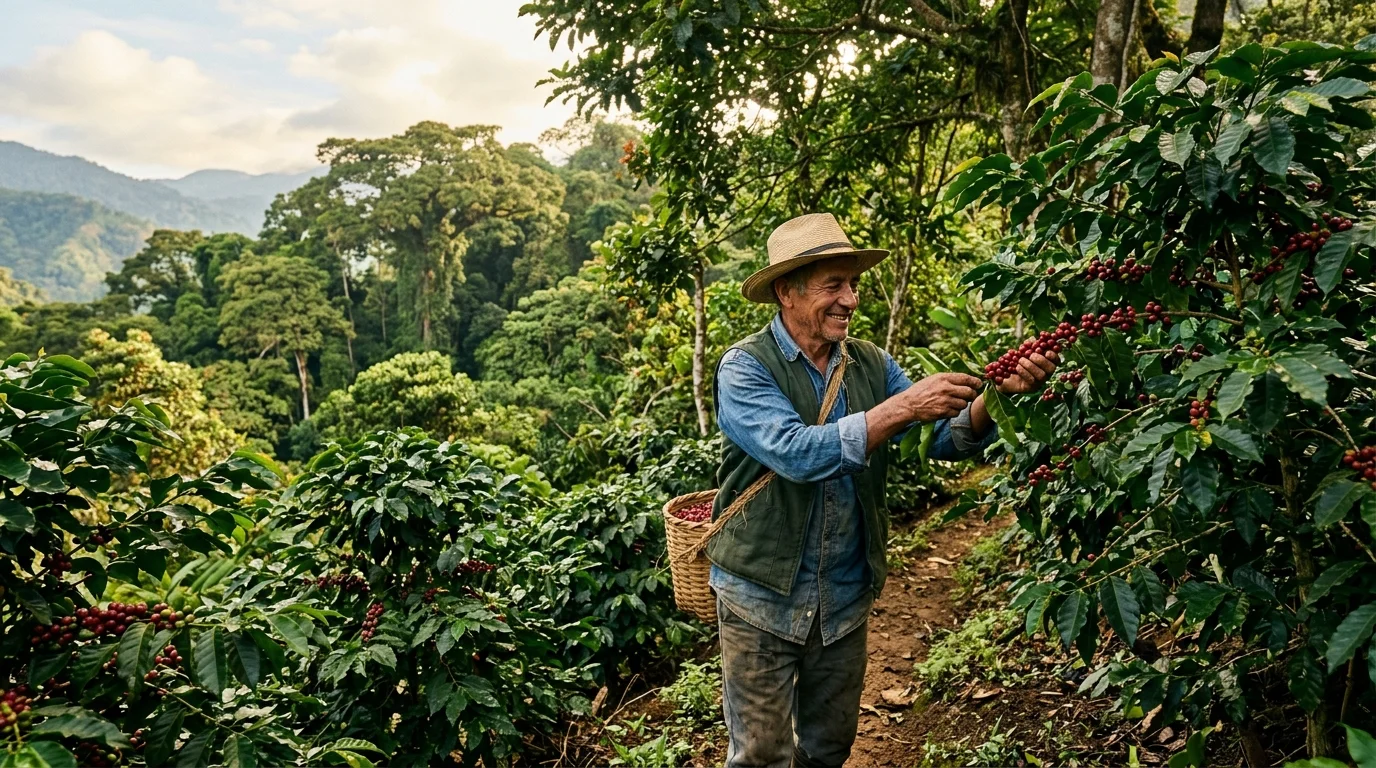
For commodities such as cocoa and coffee, the issue can be more complicated because agricultural production and tree cover may coexist on the same land. Cocoa and coffee, in particular, can be grown in agroforestry systems under the shade of larger trees. FAO zero-deforestation cocoa projects in Côte d’Ivoire themselves demonstrate that cocoa may be cultivated under different agroforestry models, including systems targeting 30–50% shade cover. The same source also notes that, in certain regions, land clearing for full-sun cocoa has created significant deforestation pressure. (fao.org)
This distinction is extremely important under the EUDR. Seeing “green” in a satellite image does not automatically mean seeing “forest”.
The legal definition in the EUDR expressly includes agroforestry systems in which crops are grown under tree cover within the concept of agricultural plantations. The Commission’s 2026 Guidance also explains that, where the predominant land use is agroforestry agriculture, the land is not considered forest merely because trees remain on it. At the same time, the Guidance draws another important boundary: limited small-scale production or agricultural activity within a forest that does not harm the forest habitat does not necessarily mean that the land has become predominantly agricultural. In other words, the EUDR does not create a mechanical rule that says “there is coffee under the trees, therefore the forest has disappeared”. The key issue is predominant land use. (eur-lex.europa.eu)
For this reason, in some cases a simple satellite algorithm that only looks for canopy loss may be insufficient. A 2020 image may show dense tree cover, and a 2026 image may still show dense tree cover. Yet if a natural or naturally regenerating forest has been economically converted into a cocoa agroforestry production area during that period, the relevant question is not simply whether a tree pixel disappeared. The question is whether the nature of the land use changed.
The same issue arises differently for wood. For wood products, the EUDR considers not only forest-to-agriculture conversion, but also certain forms of forest degradation. The current Regulation includes, within the defined degradation categories, the conversion of primary or naturally regenerating forests into plantation forests or other wooded land, as well as the conversion of primary forests into planted forests. Therefore, for wood, a conclusion such as “there were trees before and there are still trees now” will not always be sufficient. (eur-lex.europa.eu)
Why is a legal permit not enough on its own?
This is perhaps one of the most frequently misunderstood aspects of the EUDR. The Regulation does not disregard the law of producer countries. On the contrary, Article 3 requires relevant products to be both deforestation-free and produced in accordance with the relevant legislation of the country of production. Under the current Regulation, that relevant legislation may cover issues ranging from land-use rights and environmental protection to forest-management and biodiversity rules directly related to wood harvesting, third-party rights, labour rights, internationally protected human rights, FPIC, and relevant tax, anti-corruption, trade and customs rules. (eur-lex.europa.eu)
However, the existence of an official document and the completion of due diligence are not the same thing.
To understand this, it is useful to return to the historical problem from which the EUDR emerged. Years of work by INTERPOL and UNODC on forestry crime have shown that the problem is not limited to people entering forests and cutting trees without permission. Forestry crime may include illegal harvesting, cutting outside concession boundaries, laundering illegally harvested timber through plantation or agricultural companies, document fraud, false declarations, corruption, tax evasion and money laundering. INTERPOL now describes forestry crime as an area of crime that may occur throughout the supply chain, from harvesting to transport, processing and sale, and which may be facilitated by document fraud, corruption and money laundering. (interpol.int)
UNODC’s current assessment of forest crime likewise explains that corruption can arise not only at the moment of harvesting, but even at the stage of land-use decisions or the issuance of logging and land-conversion permits, and that fraudulent or improperly issued documents may be used to give legitimacy to land and timber use. (unodc.org)
This historical background explains why the EUDR was not designed as a system in which an operator simply asks the supplier for a permit, places it in a folder and closes the case.
The Commission goes further than this at the level of official guidance. Its 2026 EUDR Guidance expressly states that operators should assess whether documents are consistent with one another and with other available information, what exactly a document proves, what verification system it relies on, and whether there is a possibility that the document has been falsified or unlawfully issued. More importantly, the Guidance states that where the level of corruption in the country or region of production is high, the reliability of documentation may be weakened and additional verification may be necessary. (eur-lex.europa.eu)
This should not be interpreted as meaning that “the European Union does not trust foreign government documents”. Official records, permits, title or land-right documents, harvesting permits and similar sources may be extremely important components of due diligence. What the Regulation says is more nuanced: the fact that a document is official does not guarantee that it has been correctly linked to the actual product or that it resolves every relevant risk on its own.
For example, a supplier may present what appears to be a valid harvesting licence. But if the concession shown on the licence does not match the reported source polygon, if the declared production volume cannot reasonably be explained by the production capacity of the source, or if credible information indicates systematic document falsification in the region, the operator cannot simply ignore those inconsistencies. The EUDR does not expect the operator to become a prosecutor or a police authority, but neither does it allow the operator to close its eyes to contradictory information already in its possession.
That is the real meaning of the words “due diligence” in the EUDR. The objective is not to collect the largest possible number of documents, but to be able to explain why the available information is considered reliable.
Why is 31 December 2020 so important?

One of the best-known features of the EUDR is its 31 December 2020 cut-off date. This date was not chosen arbitrarily.
Under the current Regulation, if the land on which a relevant commodity was produced was subject to deforestation after 31 December 2020, the resulting product does not meet the “deforestation-free” requirement. For wood, this is supplemented by the condition that the wood must have been harvested without inducing forest degradation after 31 December 2020. (eur-lex.europa.eu)
The recitals to the Regulation also explain why 2020 was selected. First, the date was consistent with existing international commitments, including the 2020 targets in the Sustainable Development Goals and the New York Declaration on Forests. Second, and more interestingly, the Commission did not want the period between the announcement of the legislative proposal and the Regulation’s entry into force to create a perverse incentive along the lines of: “restrictions are coming soon, so convert the land now”. One reason for placing the cut-off date in the past was therefore to reduce the risk of this anticipatory acceleration. (eur-lex.europa.eu)
The 31 December 2020 date is therefore not merely a technical date for comparing satellite images. It is part of the economic logic of the system. The EU did not want land conversions taking place while the Regulation was being prepared to create a later market-access advantage.
This also helps explain the geolocation requirement. In order to ask, “What happened to this land after 31 December 2020?”, one must first know on which land the commodity was actually produced. Country information is not enough. Regional or provincial information will often not be enough either. The EUDR therefore seeks to link production to an actual geographic location.
However, geolocation itself should not be confused with compliance. A perfectly drawn polygon may belong to the wrong farm. A real forest parcel may be reused as the reported source for a different shipment. Satellite analysis may show no problem at all, while the land being analysed may not be the land that actually produced the commodity. Geographic verification and supply-chain provenance must therefore work together.
Risk assessment: why does the EUDR examine 14 different factors at once?
The risk assessment section in Article 10 of the EUDR can appear very broad at first sight. The Regulation lists 14 separate criteria that operators must take into account when carrying out a full risk assessment. Rather than treating these as a checklist to be memorised one by one, it is more useful to group them around four fundamental questions. (eur-lex.europa.eu)
The first question is: “What is the underlying risk profile of the geography in which the production takes place?” Article 10 requires consideration of the country’s classification under Article 29, the presence of forests in the country or region, and the prevalence of deforestation or forest degradation. None of these factors proves that a product is non-compliant; they provide the context for the risk assessment. A supply chain operating in an area with no relevant forest, long-established agricultural use and stable production patterns does not begin with the same risk profile as production expanding along an active forest frontier.
The second question is: “Who has rights over the land, and what kind of governance environment surrounds the production?” Article 10 separately considers the presence of indigenous peoples, whether good-faith consultation and cooperation has taken place with them, and whether there are objectively verifiable claims relating to the use or ownership of the land. It also expressly includes the level of corruption in the country or region, the prevalence of document and data falsification, lack of law enforcement, international human-rights violations, armed conflict, and UN or EU sanctions as relevant risk factors. (eur-lex.europa.eu)
The logic of this part is not simply to add an ethical layer to the Regulation. The fact that the coordinates of a plot are technically correct does not, on its own, prove that the producer has the legal right to use the land. Other people or communities may have valid rights over it. Likewise, the existence of a harvesting permit does not automatically eliminate credible risk indicators concerning how the permit system functions or whether the document genuinely relates to that land and activity. This is why the EUDR’s legality framework includes land-use rights, third-party rights, labour rights, human rights and FPIC. (eur-lex.europa.eu)
The third question is: “Can the product in front of me actually be traced back to the source being claimed?” Article 10 looks at the source, reliability and validity of the information collected under Article 9 and its links with other documentation; the complexity of the supply chain and its processing stages; and, in particular, the difficulty of linking the final product back to the plot on which the commodity was produced. It also treats as a separate risk the possibility of circumvention of the Regulation or the mixing of compliant products with products of unknown origin or with products from sources associated with deforestation or degradation. (eur-lex.europa.eu)
This is why supply-chain complexity is not a mechanical rule under which “more suppliers = more risk”. The Commission’s 2026 Guidance explains the reasoning behind the criterion: as the number of processors and intermediaries increases, as multiple relevant products are combined into a new product, or as commodities originate from different countries, it may become more difficult to maintain the connection back to the actual production area. Complexity is not non-compliance in itself; it becomes a risk to the extent that it weakens traceability back to source. (eur-lex.europa.eu)
The fourth question is: “Is there anything else I know outside the normal system that should raise an alarm?” This is why Article 10 also includes conclusions of Commission expert groups, substantiated concerns submitted to competent authorities, the previous record of non-compliance of operators or traders within the supply chain, any other information pointing to a risk of non-compliance, and complementary information from certification or third-party verification schemes. (eur-lex.europa.eu)
The last point is particularly important. FSC, PEFC or another certification scheme may provide highly valuable evidence, but certification does not automatically replace due diligence. The 2026 Guidance recommends that operators examine the extent to which the scheme is aligned with the EUDR standard, whether it provides traceability all the way to geolocation, how certified and non-certified material are mixed, and whether unknown-origin material is permitted. The Commission specifically does not consider the mixing of compliant material with unknown-origin material through mass balance to be acceptable under the EUDR. (eur-lex.europa.eu)
Viewed in this way, the 14 criteria are not a collection of disconnected bureaucratic requirements. They all serve the same fundamental question:
Do we know where this product came from, and how much confidence can we place in the evidence that makes us think we know?
What do low-, standard- and high-risk countries actually mean?

At this point, it is important to separate two different concepts of “risk” that are frequently confused. The first is the country benchmarking system under Article 29. The second is the operator risk assessment for a specific product and supply chain under Article 10. They are not the same thing.
Article 29 requires the European Commission to classify countries, or parts of countries, as low risk, standard risk or high risk. Low risk means there is sufficient assurance that cases in which the relevant commodities do not comply with Article 3(a), the deforestation-free requirement, are exceptional. High risk covers places where a higher risk of non-compliance has been identified, while countries falling into neither category remain standard risk. (eur-lex.europa.eu)
When carrying out this classification, the Commission relies primarily on three quantitative factors: the rate of deforestation and forest degradation, the rate of expansion of agricultural land for EUDR commodities, and production trends for the relevant commodities or products. However, the assessment is not limited to these factors. It may also consider UNFCCC commitments, agreements with the EU, the existence and effective enforcement of national or regional laws addressing deforestation, transparency of relevant data, protection of human rights and the rights of indigenous peoples and local communities, and certain international sanctions. (eur-lex.europa.eu)
As of 4 October 2026, Türkiye is classified as a low-risk country under the country classification currently in force. Belarus, the Democratic People’s Republic of Korea, Myanmar and the Russian Federation are listed as high risk; countries that appear on neither the low-risk nor high-risk list remain standard risk. Brazil, for example, currently falls within the standard-risk category. (eur-lex.europa.eu)
These classifications are not merely labels. They also affect the intensity of enforcement by competent authorities. Under the current Regulation, Member States must carry out annual checks covering at least 1% of operators, non-SME downstream operators and traders associated with low-risk sources, at least 3% for standard-risk sources and at least 9% for high-risk sources. For high-risk products, the checks must also cover at least 9% of the relevant quantity. (eur-lex.europa.eu)
However, Türkiye being low risk does not mean that “goods from Türkiye are automatically compliant”.
This distinction is particularly important for Turkish manufacturers. Low-risk sourcing may allow the use of simplified due diligence under certain conditions. If the operator, after considering supply-chain complexity and the risk of circumvention or mixing with products of unknown, standard-risk or high-risk origin, can establish that all relevant commodities and products were in fact produced in low-risk countries, it may not need to carry out the full risk assessment and risk-mitigation steps under Articles 10 and 11. However, the information-gathering requirements under Article 9 generally remain in place. If new information, a substantiated concern or another indication of non-compliance emerges, the simplified route no longer applies and Articles 10 and 11 come back into play. (eur-lex.europa.eu)
Country classification is therefore a starting assumption, not a compliance conclusion.
This distinction has considerable practical value. If a Turkish furniture manufacturer cannot demonstrate that the wood it uses was actually produced in Türkiye, the fact that “Türkiye is low risk” does not resolve the issue. If a Turkish board manufacturer sources wood from Russia or another country, the country of production of the commodity must not be confused with the country in which the final product is manufactured. What the EUDR evaluates is not simply where the final wardrobe was assembled, but where the relevant commodity was produced.
Why is the EUDR not simply a satellite system?
Because geospatial analysis and satellite imagery are among the most visible technologies associated with the EUDR, it is easy to imagine the Regulation as a system that simply says: upload a polygon, look at the satellite data, and produce a red or green result.
Satellite data is genuinely powerful. It can compare a 2020 baseline with current land cover, identify obvious forest-loss events, examine vegetation change and generate strong anomaly signals around a geometry supplied by a supplier. Given that very large numbers of plots cannot realistically be reviewed manually, it is also indispensable for automation.
But when the EUDR’s risk architecture is examined as a whole, satellite imagery is only one layer of evidence.
First, as discussed earlier, canopy cover and land use are not always the same thing. An agroforestry system may contain substantial tree cover while the predominant use is agricultural. Conversely, certain limited activities within a forest that do not damage the forest habitat may not automatically convert the land to agricultural use. A geospatial model that operates only on a “trees/no trees” basis therefore does not fully reproduce the legal test. (eur-lex.europa.eu)
Second, satellite imagery does not verify the identity of the source. A supplier may provide a polygon that genuinely exists, genuinely lies within forest land and genuinely shows no obvious problem. But if the wood, cocoa or coffee you purchased did not come from that polygon, the analysis may have been performed perfectly on the wrong piece of land.
Third, satellite data cannot see the whole of legality. Land-use rights, third-party rights, labour rights, FPIC, tax, customs and anti-corruption issues are not visible from space.
Fourth, a product may combine material from multiple sources. MDF, particleboard and other engineered wood products may include wood from a large number of sources within the same material lot. Cocoa, coffee or cattle supply chains may include aggregators and intermediaries combining products from different origins. A clean result for one polygon does not automatically clear the others.
The technical problem under the EUDR is therefore as much a provenance problem as a remote-sensing problem.
The correct chain is broadly as follows:
A product is linked to a particular commodity; the commodity is linked to specific material or production lots; those lots are linked to suppliers and upstream actors; those actors are linked to actual production plots; the plots are linked to historical land use and legality evidence; and all of this is then linked to a specific risk assessment and decision.
If that relationship cannot be reconstructed, even a highly sophisticated satellite platform is simply analysing the historical condition of the coordinates it was given. It does not know whether those coordinates genuinely belong to the product under review.
The central idea behind the EUDR
At this point, it becomes much easier to understand why so many rules that initially appear unrelated sit within the same Regulation.
The 31 December 2020 cut-off date gives the system a measurable historical point against which land conversion can be assessed. Geolocation attempts to link the commodity back to that land. The deforestation-free criterion creates a common environmental threshold even where the conversion may have been entirely lawful under the producer country’s legislation. The legality requirement then examines the same production through the lens of land rights, environmental rules, third-party rights, labour rights, human rights, FPIC, tax, anti-corruption and trade/customs requirements. The 14 criteria in Article 10 test the reliability of the information collected and its connection with the actual product. The Article 29 benchmarking system establishes the starting geographic risk level in which those assessments take place. (eur-lex.europa.eu)
These are therefore not independent compliance requirements added together later. They are different layers of the same trust problem.
Is the source claimed by the supplier correct?
If the source is correct, did the land undergo an unacceptable conversion after 31 December 2020?
If no problematic land-use change is detected, could the production still breach relevant local law?
If an official document exists, does that document really relate to this land, this period and this product?
Does the governance environment in which the document was issued create a material risk of corruption or falsification that affects its reliability?
Was the product mixed with other sources as it moved through processors and traders?
Does the certificate genuinely cover this lot?
Even if the polygon provided by the supplier is real, what evidence demonstrates that the commodity purchased actually came from that polygon?
The EUDR is designed around the fact that answering only one of these questions is not enough.
For that reason, it is incomplete to view the Regulation solely as environmental law. The EUDR is also a supply-chain transparency, provenance and evidence-reliability regulation.
The European Union cannot directly run another country’s land-use policy. It cannot decide which areas in Brazil may be converted to agriculture, write cocoa policy in Côte d’Ivoire, or determine Türkiye’s forestry legislation. What it can do is define the conditions for access to its own market. The political line running from the Commission’s 2019 Communication to the 2021 proposal is built around precisely this demand-side approach: the EU seeks to reduce the global deforestation footprint associated with its own consumption. (eur-lex.europa.eu)
To do that, rather than telling producers “never cut a tree”, it requires something much more difficult:
Be able to show the land, the supply chain and the evidence behind the product you are selling into my market.
And where a reasonable doubt emerges at any point in that chain, do not ignore it simply because there is a document in the file.
That is the essence of the EUDR.
The issue is not two trees being cut down. The issue is forests being systematically converted to another economic use, commodities resulting from that conversion losing their identity within complex supply chains, and those commodities eventually reaching consumer markets on the other side of the world as though no connection existed.
The EUDR is an attempt to make that connection visible again.
That is why the correct question is not, “Are there still trees there?”
The correct question is:
What happened to the land on which this product was produced after 31 December 2020, did the product genuinely come from that land, and how reliable is the evidence that makes us believe it did?
Only when that question can be answered do geolocation, satellite imagery, supplier evidence, certification, ERP records and risk engines begin to have real meaning. If it cannot be answered, a green polygon on a map or an official document sitting in a folder does not, by itself, constitute a genuine due diligence system.
Source review date: 4 October 2026. This article is based on the 18 September 2026 consolidated version of Regulation (EU) 2023/1115, the European Commission’s EUDR Guidance of 20 July 2026, the country benchmarking regulation currently in force, FLEGT and EUTR sources, and material from the FAO, INTERPOL and UNODC. The main EUDR obligations generally apply from 30 December 2026; for certain undertakings that qualified as micro or small enterprises on 31 December 2024, the general application date extends to 30 June 2027, while specific transitional rules apply to certain wood products previously covered by the EUTR. (eur-lex.europa.eu)