
EUDR Compliance Guide for the Furniture Sector: Wood, MDF, Particleboard and Supplier Traceability
EUDR guide for furniture manufacturers: trace wood, MDF and particleboard from supplier lots to source plots, evidence and shipment review.

EUDR in the Furniture Sector: A Practical Guide to Wood, MDF, Particleboard, Geolocation and Supplier Traceability
For a furniture manufacturer, preparing for the EUDR is not simply a matter of answering the question, “Where did the wood come from?”
A cabinet may contain MDF, particleboard, veneer, plywood and solid wood. The same product model may be manufactured at different times using material from different board suppliers. A single board may contain wood from multiple sources. Some inputs may be recovered material, while others may be virgin wood. A supplier’s FSC or PEFC certificate may be genuine and valid, but this does not necessarily prove, on its own, that the wood used in a specific shipment complies with the EUDR.
For this reason, the real EUDR challenge in the furniture sector is not document storage. It is the ability to create a reconstructable chain between the product, the material actually used, the supplier, the place of production, geolocation, evidence and the final decision.
This guide focuses particularly on the operational issues faced by furniture manufacturers producing outside the EU, including in Türkiye, and selling their products into the European Union.
For the wider product-data context, see our furniture industry overview and timber supply-chain guide. For the product workflow, explore the UCVreg EUDR module.
What is the EUDR and why does it matter to the furniture sector?
The EU Deforestation Regulation, Regulation (EU) 2023/1115, aims to ensure that certain commodities and products placed on or exported from the EU market are not associated with deforestation or forest degradation.
The EUDR covers seven main commodities: cattle, cocoa, coffee, oil palm, rubber, soy and wood. For the furniture sector, the critical commodity is naturally wood. Annex I of the Regulation includes various wood products, panels, plywood, certain seats, furniture and furniture parts. (environment.ec.europa.eu)
The basic rule under the EUDR is built around three separate conditions. The relevant product must be deforestation-free, it must have been produced in accordance with the relevant legislation of the country of production, and, where applicable, it must be covered by the required Due Diligence Statement or simplified declaration. One condition does not replace another. (eur-lex.europa.eu)
This distinction is particularly important. The fact that a tree was harvested under a permit issued by a local authority does not automatically mean that the resulting product complies with the EUDR. Harvesting may have been legal while the product still fails the Regulation’s “deforestation-free” requirement or, in the case of wood, its forest-degradation requirement. Conversely, the absence of an obvious problem in satellite imagery does not by itself prove that production complied with all relevant laws in the country of production.
When does the EUDR start to apply?
The EUDR implementation timetable has changed several times. As of 4 October 2026, the main obligations are scheduled to apply to large and medium-sized operators from 30 December 2026.
For undertakings that qualified as micro or small enterprises on 31 December 2024, the general application date is 30 June 2027. However, for certain micro and small enterprises previously covered by the EU Timber Regulation, the 30 December 2026 date continues to apply. (environment.ec.europa.eu)
These dates matter because the EUDR is not merely a future sustainability-reporting requirement. It becomes one of the legal conditions governing whether relevant products may enter the EU market.
The exact penalties will be implemented through national legislation in the Member States, but the EUDR requires the maximum level of fines for legal persons to reach at least 4% of total EU-wide turnover in the preceding financial year. The Regulation also provides for measures including confiscation of relevant products or revenues, temporary exclusion from public procurement and, in serious or repeated cases, temporary prohibition from placing relevant products on the market. (eur-lex.europa.eu)
It is therefore a mistake to treat the EUDR simply as another ESG-reporting exercise or as a new questionnaire to send to suppliers.
Which furniture products fall within scope?
The first question is not whether a product contains wood, but whether the product’s Combined Nomenclature — CN code and Annex I classification place it within scope.
Commission Delegated Regulation (EU) 2026/2102, which entered into force in September 2026, amended Annex I. In the furniture sector, wooden furniture and parts falling under categories such as ex 9403 30, ex 9403 40, ex 9403 50, ex 9403 60 and ex 9403 91 remain listed. The amendment also excluded used and second-hand goods from those entries. Certain seats with wooden frames are likewise defined through more detailed CN codes. (eur-lex.europa.eu)
For this reason, both “the product contains wood, therefore it is covered” and “this is furniture, therefore it must be covered” are insufficient approaches.
For a dining table, chair, bedroom set or furniture component, the current CN classification should first be established and then matched against Annex I.
Regulation 2026/2102 also amended the EUDR product scope in other areas. The Commission set 30 December 2027 as the application date for newly added products, but that postponement does not mean that existing furniture categories that have long been included in Annex I are generally postponed until 2027. (environment.ec.europa.eu)
Is a Turkish furniture manufacturer an “operator” under the EUDR?
This is one of the most frequently confused issues for exporters based outside the EU.
The legal role under the EUDR is not determined solely by who physically manufactures the product. It also depends on who first places the product on the EU market and where the relevant actors in the supply chain are established.
Under Article 7, where a person established outside the EU places a relevant product on the EU market, the first person established in the EU who makes that relevant product available on the market is considered the operator for EUDR purposes. (eur-lex.europa.eu)
A furniture factory in Türkiye and an importer in Germany, France or the Netherlands may therefore have different legal roles.
However, this does not mean that “the Turkish manufacturer has nothing to do with the EUDR”.
On the contrary, an EU operator may need to obtain from the manufacturer information on wood species, country of production, production areas, geolocation data, supply-chain links and supporting evidence in order to perform its due diligence. A manufacturer unable to provide such information systematically may become a significant commercial risk for its EU customer.
For that reason, the objective of an exporting furniture manufacturer should not be merely to “submit a DDS”. The objective should be to produce an EUDR-ready supplier evidence package capable of supporting the EU customer’s due diligence and DDS process.
The central challenge in furniture: tracing the finished product back to the forest
In furniture production, the hardest part of the EUDR is often not the finished product itself.
The difficult part is everything that happens in between.
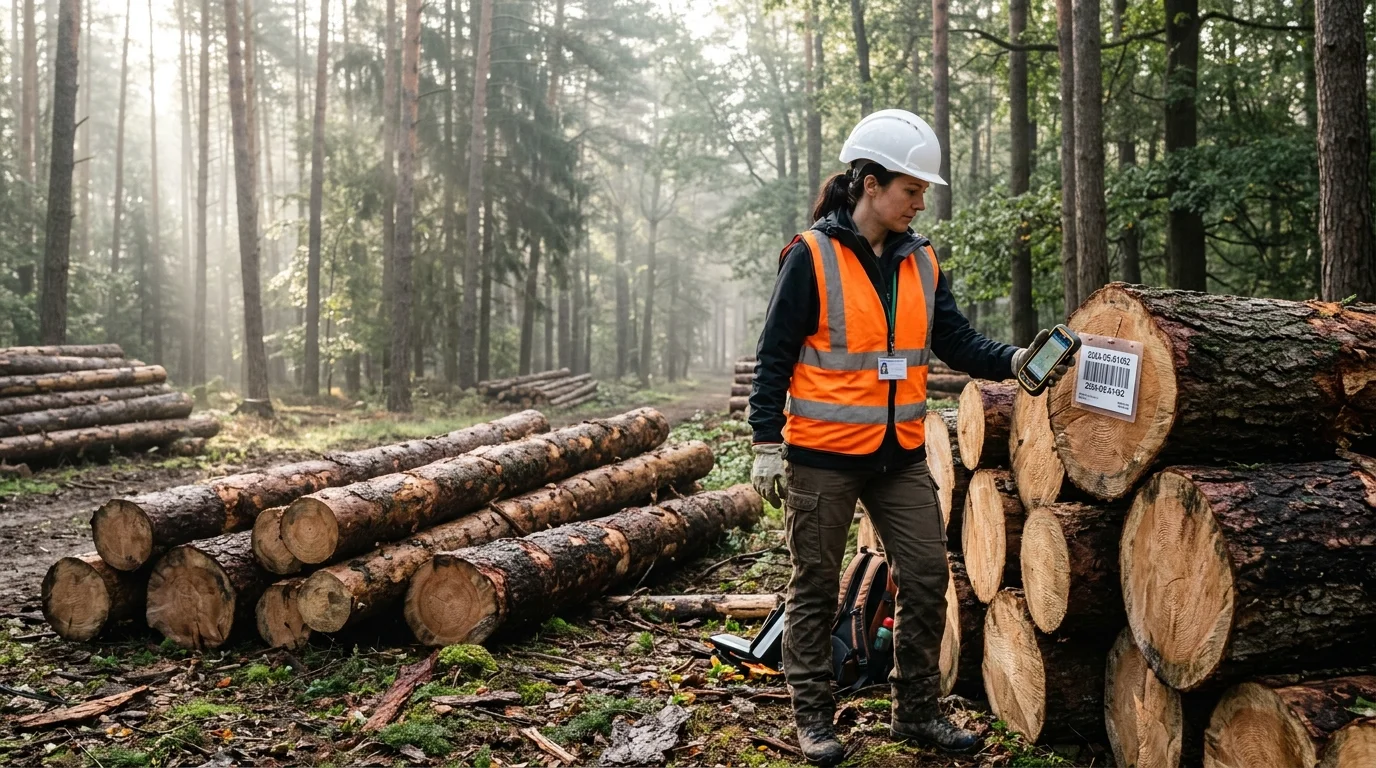
A tree becomes a log. A log becomes timber or fibre. Fibre may become MDF. Fibres from different sources may be combined in the same board. The board may pass through a distributor before reaching the furniture factory. The same cabinet model may use MDF from Supplier A in one production period and MDF from Supplier B a few months later.
The final SKU may be identical. The wood source may not be.
The Commission’s current guidance treats supply-chain complexity as a separate risk factor. More intermediaries and processing stages, the use of multiple relevant products within a new product, or raw material coming from several countries can increase traceability difficulties. The fundamental question is whether the relevant commodity within the finished product can be traced back to the plot where it was produced. (eur-lex.europa.eu)
A practical EUDR data model should therefore be capable of representing at least the following logic:
Supplier → purchased material → delivery/lot → source or sources → actual production use → finished-goods batch → shipment → EUDR review
The critical expression here is “actual production use”.
A Bill of Materials stating that a product uses “18 mm MDF” does not identify which supplier lot was actually consumed in production.
For EUDR purposes, the actual material flow may therefore be more important than the theoretical recipe.
Why are MDF, particleboard, OSB and plywood more difficult?
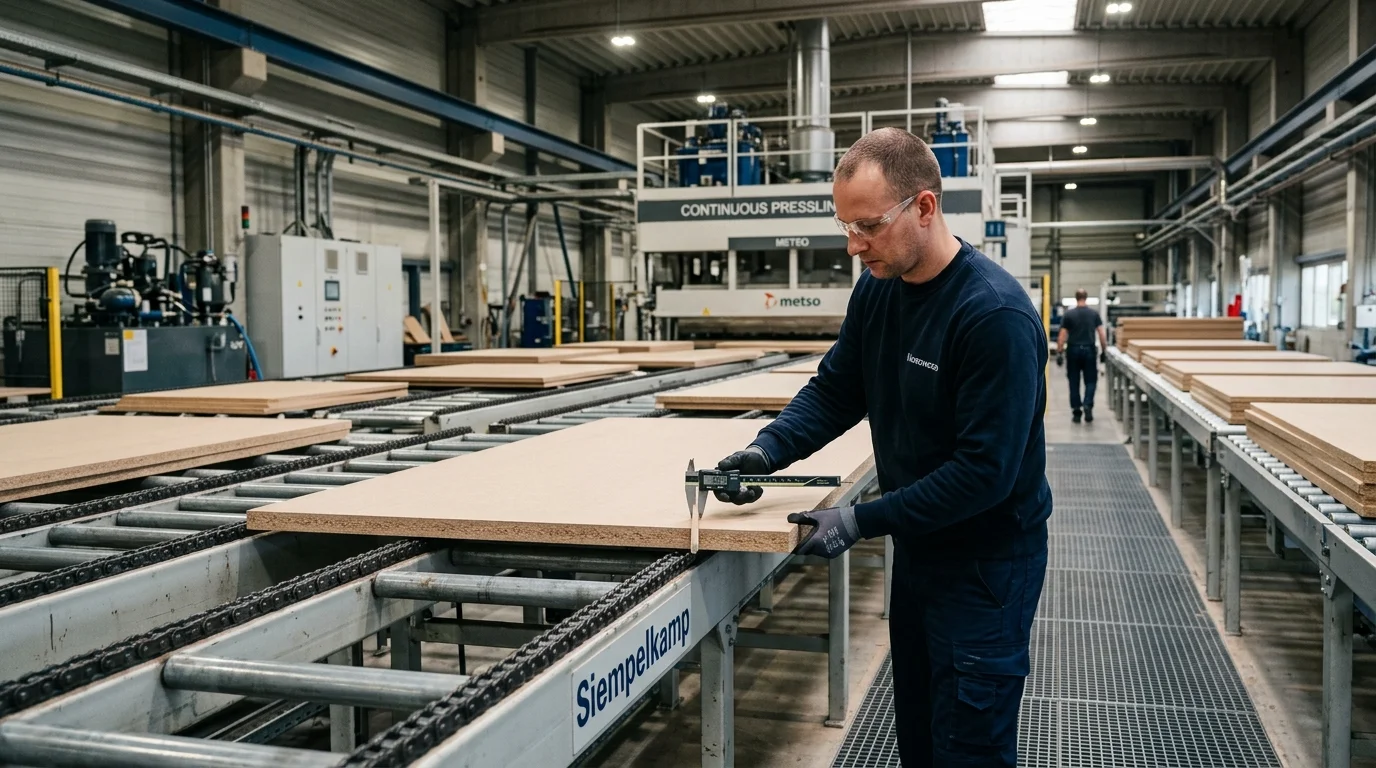
With solid wood, the relationship to source may in some cases be relatively direct. With reconstituted wood products, the problem is different.
Particleboard, MDF and similar panels may combine material from numerous wood sources. The Commission’s guidance specifically recognises that identifying species, origin and geolocation for products such as fibreboard and particleboard can be complex. Nevertheless, where the product falls within scope, the information requirements under Article 9 do not disappear. (environment.ec.europa.eu)
For relevant products containing or made from wood, the common name and the full scientific name of the tree species must also be collected. Where source or species may vary, the appropriate set of possible species must be recorded. (eur-lex.europa.eu)
This demonstrates why simply asking a panel supplier, “Are you EUDR compliant?” is not enough.
A better question is:
“Which wood sources are contained in this panel lot that you supplied to us, and which production areas and EUDR evidence are associated with those sources?”
That small difference in wording can change the entire data architecture of an EUDR project.
Composite products: are all materials in a piece of furniture assessed in the same way?
No.
It would be incorrect to interpret the EUDR’s composite-product approach as meaning that every raw material contained in the finished product automatically becomes subject to the EUDR.
The Commission’s guidance explains that the relevant commodity under which the product is listed in Annex I should be considered. For example, if a piece of furniture containing both wood and leather is listed as a relevant product under wood in Annex I, the leather component does not automatically create a separate cattle-commodity EUDR obligation simply because leather is present in the product. (environment.ec.europa.eu)
However, the relevant wood components of the product must still be traced.
A cabinet may, for example, contain an MDF body, solid beech legs and oak veneer. It would be incorrect to assume that all three necessarily share the same source.
Each may have a different supplier, country of production, lot and set of source plots.
Is recycled or recovered wood outside the EUDR?
In some circumstances, yes, but the word “recycled” alone is not enough.
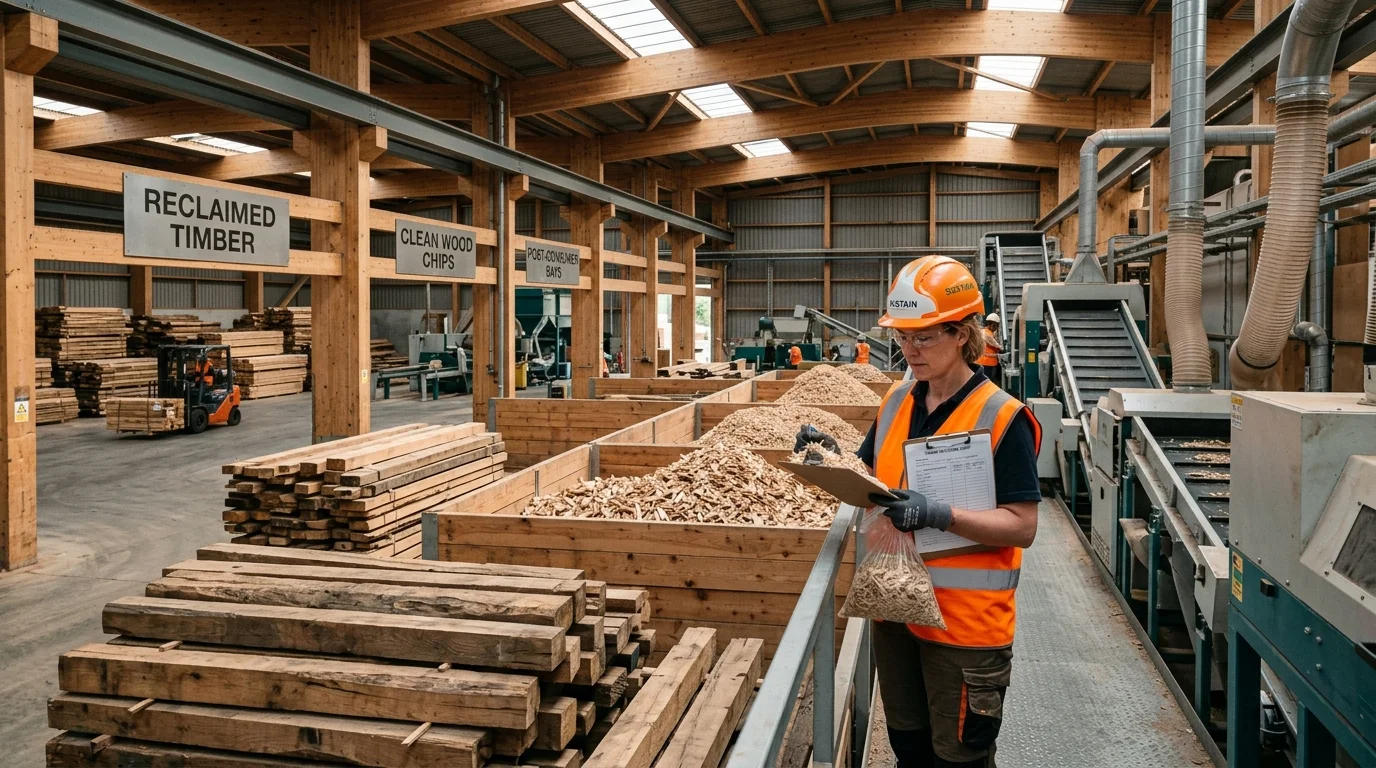
The Commission’s 2026 Guidance makes a clear distinction. Products made entirely from material that has completed its lifecycle and would otherwise have been discarded as waste may fall outside the EUDR.
For example, furniture produced entirely from timber recovered from a demolished building may benefit from this exclusion.
However, if the product contains any virgin or otherwise non-recycled material, that component remains subject to EUDR assessment. (eur-lex.europa.eu)
For example, if a board consists of 70% genuinely post-consumer recovered wood and 30% virgin wood, it would not be correct to remove the entire board from the EUDR file simply by describing it as “recycled”.
The virgin portion still needs to be traced.
A similar mistake can occur with sawdust or cutting residues generated during production. The Commission specifically states that by-products such as sawmill wood chips and sawdust are not automatically outside the EUDR merely because they are described as “waste” or “residue”. If they are production by-products rather than material that has completed its lifecycle as waste, their treatment differs. (eur-lex.europa.eu)
An ERP label such as “scrap”, “waste” or “recycled” is therefore not itself a legal classification.
Is mass balance sufficient for the EUDR?
This is particularly relevant in certified timber and board supply chains.
Some certification or chain-of-custody systems allow certified material and material of a different status to be mixed under defined accounting rules.
Under the EUDR, however, compliant material cannot be mixed with material of unknown origin under a mass-balance approach.
The Commission’s guidance expressly states that chain-of-custody systems that mix known-origin and unknown-origin material, or compliant material with material of unknown origin under mass balance, are not acceptable for EUDR purposes. (environment.ec.europa.eu)
This does not mean that physical mixing is prohibited in every case. Wood from multiple sources may be combined in a single panel.
The problem arises where one or more of those sources are unknown or have not undergone the required EUDR assessment.
An MDF lot may, for example, contain wood from 40 production plots. In principle, having many sources is not itself a problem if all of those sources are known and the required EUDR information is available.
But an approach such as “80% of this product comes from compliant sources and we do not know where the remaining 20% came from” does not meet the EUDR traceability logic.
What does geolocation actually mean?
Under the EUDR, geolocation does not mean the Google Maps coordinates of the factory where the furniture was manufactured.
Article 9 requires geolocation information for all plots of land on which the relevant commodity was produced. Where the wood contained in a product came from several plots, all relevant production plots must be taken into account. (eur-lex.europa.eu)
The definition of geolocation is based on latitude and longitude coordinates with at least six decimal digits. For commodities other than cattle, production plots larger than four hectares must be defined using polygons. (eur-lex.europa.eu)
For furniture manufacturers, the difficult part is usually not displaying coordinates on a map.
The more important questions are whether the coordinates genuinely correspond to the source of the wood in the relevant board, whether the supplier’s polygon covers the correct lot, which production period the plot relates to, whether the same coordinates are being repeatedly reused for unrelated deliveries, and whether all sources have been recorded where a panel contains wood from multiple origins.
Geolocation is therefore not fundamentally a file-format problem. It is an identity and relationship problem.
Can satellite imagery automatically determine EUDR compliance?
No.
Earth-observation data can be extremely valuable, but its role needs to be defined correctly.
Satellite or remote-sensing information may be used to investigate changes in land cover over time, identify forest-loss signals or cross-check a supplier declaration.
The Commission’s guidance lists Earth-observation sources such as Copernicus among the technical and scientific tools that may be used. The same guidance also stresses that the Commission’s EU Observatory tool is free to use but non-mandatory and does not itself have legal value. (eur-lex.europa.eu)
A green polygon on an EUDR platform therefore does not mean “compliant”.
Satellite data may tell you something about the parcel. It does not tell you whether that polygon genuinely produced the MDF purchased by your company.
That comes from supply-chain evidence.
Nor can satellite imagery by itself verify the validity of harvesting rights, land-use rights, third-party rights or compliance with taxation and trade legislation.
For that reason, geospatial assessment and due diligence are not substitutes for one another.
Deforestation and forest degradation are not the same thing
This distinction is particularly important for furniture and timber.
The EUDR defines “deforestation” as the conversion of forest to agricultural use, whether human-induced or not. The key cut-off date for the deforestation-free requirement is 31 December 2020. (eur-lex.europa.eu)
For wood, there is an additional requirement.
Wood must have been harvested without inducing forest degradation after 31 December 2020.
The EUDR’s definition of forest degradation covers certain structural conversions, including the conversion of primary or naturally regenerating forests into plantation forests or other wooded land, and the conversion of primary forests into planted forests. (eur-lex.europa.eu)
For timber, analysis therefore cannot always stop at “there were trees here in 2020 and there are still trees here today”.
In some scenarios, trees may be visible in both images while the forest structure has nevertheless changed in a legally relevant way.
This is one of the areas where geospatial analysis for timber may differ from a more conventional forest-to-agriculture check for commodities such as cocoa or coffee.
If the local authority authorised the harvesting, is the product compliant?
Not by itself.
This is a very important operational distinction.
Article 3 of the EUDR treats “deforestation-free” and compliance with the “relevant legislation of the country of production” as separate requirements. A harvesting permit, land-use authorisation or decision from a forestry authority may therefore be important evidence of legal production, but it does not automatically satisfy the other EUDR conditions. (eur-lex.europa.eu)
The concept of “relevant legislation” is also broader than a harvesting licence.
The Regulation may cover land-use rights, environmental protection, forest-management and biodiversity rules directly related to wood harvesting, third-party rights, labour rights, human rights protected under international law, FPIC and relevant tax, anti-corruption, trade and customs rules. (eur-lex.europa.eu)
This does not mean that hundreds of legal documents must be collected for every shipment.
The Commission’s 2026 Guidance explains that the scope of evidence collected should be proportionate to the actual supply chain, production area and country risk, and that in low-risk situations it may not be necessary systematically to collect every conceivable legal document for every plot. (eur-lex.europa.eu)
If Türkiye is low risk, are all these controls still necessary?
Türkiye is currently classified as a low-risk country under the EUDR benchmarking system. Commission Implementing Regulation (EU) 2025/1093 expressly includes Türkiye in the low-risk list. (eur-lex.europa.eu)
This is an important advantage for the Turkish furniture and wood sectors.
But “low risk” does not mean “outside the EUDR”.
Operators sourcing from low-risk countries may benefit from simplified due diligence under Article 13. Before doing so, they must consider the complexity of the supply chain, the risk of circumvention and the possibility of mixing with products of unknown, standard-risk or high-risk origin, and establish that the products genuinely originate only from low-risk sources. (eur-lex.europa.eu)
Where those conditions are met, the full risk assessment under Article 10 and risk mitigation under Article 11 may not normally be required.
However, the information requirements under Article 9 do not disappear. The Commission’s current guidance expressly confirms that operators using the low-risk simplified route must still collect the Article 9 information and maintain a due diligence system. If new information or a substantiated concern arises, the normal risk-assessment and mitigation requirements may become applicable again. (eur-lex.europa.eu)
“Türkiye is low risk, therefore geolocation is not required” is therefore incorrect.
A more accurate statement is:
Türkiye’s low-risk classification can significantly simplify the process; it does not eliminate traceability.
Is an FSC or PEFC certificate sufficient?
Not on its own.
Certification and third-party verification systems can provide valuable evidence in an EUDR process. They may significantly reduce the operational burden in areas such as chain of custody, producer controls, geolocation or legal sourcing.
However, the Commission’s guidance makes clear that certification is not mandatory and does not replace the operator’s responsibility under the EUDR.
In other words, FSC or PEFC may be supporting evidence, but it is not an automatic green lane. (eur-lex.europa.eu)
A furniture manufacturer should therefore not treat certification as a simple yes/no field.
It matters which company, facility, material, period and chain-of-custody method the certificate actually covers.
Where a certification system permits certain mass-balance models involving unknown-origin material, that also requires separate consideration under the EUDR. (eur-lex.europa.eu)
What evidence should be requested from suppliers?
The purpose of supplier onboarding should not be to force a supplier to complete hundreds of fields.
The purpose is to establish the smallest but sufficient dataset needed to link a specific material to its actual source.
For a furniture manufacturer, a strong supplier-evidence process should be able to answer questions such as: Which material and delivery lot does this information relate to? What is the country of production? Which tree species are involved? What are the relevant production plots? What is the source of the geolocation information? What production or harvesting period does it cover? Is the supplier relying on another DDS or declaration reference for this material? If recycled or recovered content is claimed, what proportion or component does that claim apply to and what supports it? Has the source changed since the previous delivery?
All of this information might be contained in one PDF.
The problem is not that it is a PDF.
The problem is not knowing which real-world object the PDF applies to.
A document-management system and an evidence model are therefore not the same thing.
How should “evidence” be modelled in EUDR software?
One of the most common design mistakes in EUDR platforms is creating a supplier folder and placing every document inside it.
That solves document storage.
It does not solve due diligence.
It is important not only to know which supplier a document relates to, but also which material, lot, production period, plot, claim or shipment it supports.
For example, the fact that a supplier has uploaded a sustainability certificate valid for 2026 does not necessarily mean that a specific MDF lot delivered in December falls within that certificate’s scope.
The software should therefore model a relationship such as claim → evidence → review → decision.
A certificate supports a claim.
A polygon supports a production-source claim.
A satellite assessment provides one control layer for deforestation risk on that polygon.
A harvesting permit may contribute to the legality assessment.
A reviewer then makes a decision on the basis of the combined evidence.
Without such a model, users may eventually see hundreds of green ticks on a dashboard while still being unable to explain why a particular shipment was accepted.
Why can the same product code not always use the same EUDR file?
Consider a simple example.
A manufacturer produces the same wardrobe model throughout the year.
In January, the body uses MDF from Supplier A. The veneer comes from Supplier B.
In June, the product code, design and BOM remain unchanged, but the purchasing team switches the MDF supplier to Supplier C.
From an ERP perspective, the final SKU may still be the same.
From an EUDR perspective, the source chain has changed.
Supplier B’s veneer evidence may still be valid. But Supplier A’s MDF source file should not automatically be carried across to the June shipment.
A strong EUDR system must therefore be able to work not only at product-master level, but, where necessary, at material lot, batch, production run and shipment level.
What should happen when the source is unknown?
“Unknown” is a valid operational status in an EUDR system.
It is not the same as “compliant”.
If the supplier has not yet provided the polygon, if a document applies to the wrong period, if the source relationship cannot be established or if a geolocation file is corrupt, the system should show that clearly.
Guessing a missing value, copying a polygon from another supplier or inserting a generic country-level location may make the system look cleaner, but it makes the compliance position worse.
A good workflow should expose the problem and route it to the right person rather than conceal it.
Statuses such as “evidence requested”, “evidence received”, “review required”, “correction requested”, “approved” and “blocked” should therefore remain distinct.
A risk engine may help prioritise review.
But the risk score should not replace an understandable decision.
Is there a single official EUDR risk-score formula?
No.
The EUDR does not provide a single percentage formula under which every company must treat, for example, “73/100” as compliant or non-compliant.
Article 10 defines risk-assessment criteria and the objective is to determine whether the risk of non-compliance can be reduced to no risk or only negligible risk. Supply-chain complexity, country risk, forest prevalence, circumvention risk and the reliability of available information may all form part of that assessment. (eur-lex.europa.eu)
A software platform may of course create an operational risk score.
For example, a satellite alert, missing legality evidence, a new supplier and a source mismatch might push a case into a high-review-priority queue.
The reviewer then examines the evidence.
The score manages the operation.
The evidence and due diligence support the decision.
Why does ERP integration matter?
For large furniture manufacturers, the EUDR platform should not become the company’s second ERP.
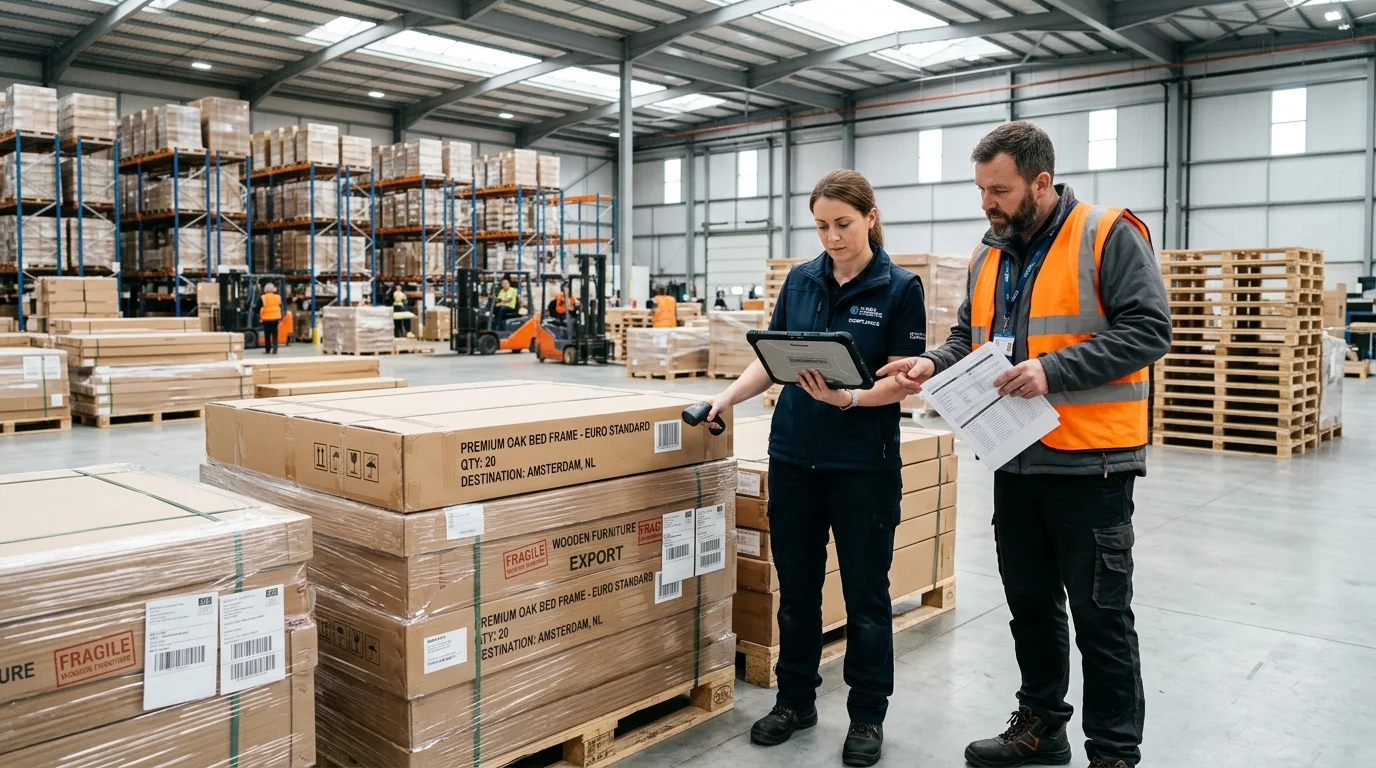
The ERP may already contain SKU, purchase order, goods receipt, supplier, shipment and some batch information.
The EUDR system should enrich those records with compliance context rather than recreate them.
For example, the ERP may provide:
PO → Supplier → Material → Goods Receipt → Batch.
The EUDR system can then add source plots, supplier evidence, species, country of production, risk assessment, reviewer decision and, where required, DDS references.
There is another important benefit.
Where a supplier name changes in the ERP or a material code is revised, the compliance platform can identify which objects may need reassessment.
This is why idempotency and source identifiers are critical in integrations.
If the same SAP record creates a new supplier or a new shipment every time it is imported overnight, the EUDR platform quickly becomes unusable.
Real-world scenario 1: a wardrobe shipped from Türkiye to Germany
A Turkish manufacturer sells an Annex I wooden wardrobe to a German importer.
The wardrobe contains MDF in the body, veneer in the doors and solid wood in the legs.
The first step is to confirm the product’s CN classification.
The relevant wood inputs are then identified.
The MDF comes from three source sets linked to Supplier A, while the veneer comes from a single source linked to Supplier B.
The manufacturer links its production batch to the material lots actually consumed.
Supplier evidence is linked to those lots.
If the German importer is the EUDR operator, it conducts the required due diligence and DDS process; the Turkish manufacturer becomes a critical upstream actor providing the evidence needed to support that process. Article 7 regulates the situation in which a person established outside the EU places a product on the market and the first EU-established person making it available becomes the operator. (eur-lex.europa.eu)
The important output is not a file called “wardrobe compliant.pdf”.
The important output is the ability to reconstruct the wood sources behind that shipment.
Real-world scenario 2: a board containing 70% recovered wood and 30% virgin wood
A board supplier declares that a panel contains 70% recovered wood and 30% virgin wood.
If the furniture manufacturer records only “recycled = yes”, important information is lost.
First, evidence supporting the claim that the 70% recovered component genuinely qualifies for the relevant waste/recovered-material exclusion should be retained.
Then the source of the 30% virgin component must be traced.
The Commission’s guidance draws a clear distinction between products made entirely from recovered material and products containing any amount of non-recycled material. (eur-lex.europa.eu)
“Recycled content” should therefore be treated as a claim with its own supporting evidence rather than as a simple checkbox.
Real-world scenario 3: the supplier provides an FSC certificate but no geolocation
A supplier submits a valid FSC certificate.
This is a useful starting point.
But if the certificate does not provide the source-plot information for the relevant material lot, the Article 9 geolocation requirement does not disappear.
The operator may use the certificate as supporting evidence in its due diligence, but the other required information must still be obtained.
The Commission explicitly states that certification schemes do not replace the operator’s EUDR due diligence responsibility. (eur-lex.europa.eu)
The correct workflow is not to reject the certificate.
It is to accept the certificate while opening a separate requirement for the missing geolocation evidence.
Real-world scenario 4: the polygon is clean, but the supplier relationship is suspicious
A supplier provides a polygon in Türkiye.
Satellite analysis shows no obvious post-2020 forest-loss signal.
Technically, the map is “green”.
However, the same supplier uses the same polygon for products coming from two different sawmills hundreds of kilometres apart.
This is not primarily a remote-sensing problem.
It is a traceability problem.
The system should flag the supplier → material → source relationship for review.
This scenario demonstrates why purchasing a satellite API alone does not create an EUDR system.
What should companies look for when choosing EUDR software?
The strongest EUDR platform is not necessarily the product with the longest feature list.
It is more useful to test a realistic difficult case during a demonstration.
For example, create a small shipment involving two suppliers, three MDF lots, one expired certificate, a changed polygon, 30% virgin content and one rejected document.
Then ask:
“Could another employee reconstruct from scratch, six months from now, why this shipment was approved?”
If the answer is yes, there is a good chance the evidence model is sound.
If the answer is simply “the dashboard is green”, that is not enough.
Supplier onboarding, source/plot management, material-lot relationships, versioning, correction workflows, document hashing, reviewer history, risk flags, ERP integration, exportability and DDS/Information System integration capability should all be assessed together.
The EUDR Information System itself is no longer based solely on the original model. Following the 2025 amendments, obligations for downstream operators and traders were simplified, while 2026 Information System updates added support for simplified declarations and revised roles alongside Due Diligence Statements. (environment.ec.europa.eu)
Software buyers should therefore distinguish between products that still reproduce a 2024-era EUDR workflow and products that reflect the current legal role structure.
What changed for downstream operators and traders after 2025?
Regulation (EU) 2025/2650 significantly simplified supply-chain obligations in December 2025.
Under the revised framework, due diligence and DDS responsibility is more heavily concentrated at the first-operator level. “Downstream operator” became a separate category, and downstream operators and traders are no longer required to create a new DDS for every transaction.
Instead, it became more important to preserve information such as DDS references or declaration identifiers received from first operators through the supply chain. Non-SME downstream operators and traders also have certain registration obligations in the Information System. (eur-lex.europa.eu)
Being downstream does not, however, mean having no responsibility.
Where new information or substantiated concerns emerge, competent authorities and subsequent supply-chain actors may need to be informed. Non-SME downstream operators and traders must also verify, in certain non-compliance situations, that due diligence has been performed and that the risk has been found to be negligible. (eur-lex.europa.eu)
This matters for software architecture as well.
A platform should understand the difference between an operator, downstream operator and trader instead of forcing every company through the same DDS workflow.
Can you reproduce the evidence five years later?
Versioning is one of the most overlooked parts of EUDR operations.
It is not enough to look at Supplier A’s profile today and see the current certificate.
Which document was used when a shipment was assessed three years ago?
Which polygons had the supplier declared at that time?
Was the species information subsequently changed?
Which risk result did the reviewer rely on when approving the case?
Was a newer version of a document simply written over the older version?
Under Article 12, operators must retain documentation relating to due diligence for at least five years. (eur-lex.europa.eu)
An EUDR audit log should therefore be more than “Halit edited the record at 14:32”.
It should preserve the version history required to reconstruct the decision.
Where should furniture manufacturers start today?
The best starting point is not to create a 400-question supplier questionnaire.
Start with one real product family.
For example, select a high-volume wardrobe.
Confirm its current CN code. Identify the actual wood inputs used in the most recent production batch. Find the corresponding ERP purchase records and material lots. Then work backwards to the suppliers and identify the wood-source information behind those inputs.
Test the chain in reverse:
Shipment → finished batch → material lot actually used → supplier delivery → wood source → production plot → evidence.
Wherever that chain breaks, you have found the first real item in your EUDR backlog.
In many cases, this exercise is more useful than a lengthy generic gap assessment.
Frequently Asked Questions
Are MDF and particleboard covered by the EUDR?
They can be. Annex I includes particleboard, OSB, fibreboard and various engineered-wood products. The final scope decision should be based on the relevant CN code and classification. The Commission’s guidance specifically recognises that source and species information can be complex for reconstituted products such as fibreboard and particleboard, while confirming that the relevant traceability requirements still apply. (eur-lex.europa.eu)
If only a small percentage of the furniture is wood, does the EUDR still apply?
The EUDR does not establish a general “percentage of wood” threshold. The first question is whether the finished product is listed under the relevant CN code in Annex I. Scope should not be decided solely by looking at the proportion of wood content.
Is Türkiye a low-risk country under the EUDR?
Yes. Under the current Commission Implementing Regulation (EU) 2025/1093, Türkiye is classified as a low-risk country. (eur-lex.europa.eu)
If Türkiye is low risk, does that mean geolocation is unnecessary?
No. Low-risk classification may allow simplified due diligence, but the Article 9 information requirements generally remain. Simplified due diligence mainly changes the application of the Article 10 risk assessment and Article 11 risk mitigation requirements under certain conditions. (eur-lex.europa.eu)
Is a polygon required for plots smaller than four hectares?
For commodities other than cattle, the EUDR geolocation definition requires polygons for plots larger than four hectares. Smaller plots may be represented using latitude and longitude points. Coordinates must contain at least six decimal digits. (eur-lex.europa.eu)
What happens if one MDF board contains wood from hundreds of source plots?
Where a relevant product contains commodity produced on different plots, the geolocation of all relevant production areas may need to be included. This is why source aggregation and traceability are significant system challenges for engineered-wood products. (eur-lex.europa.eu)
Is FSC certification enough for EUDR compliance?
Not on its own. Certification and third-party verification systems may provide valuable evidence for due diligence and risk assessment, but they do not replace the operator’s EUDR responsibility. (eur-lex.europa.eu)
Is furniture made entirely from recovered wood outside the EUDR?
Where the material genuinely completed its lifecycle and would otherwise have been discarded as waste, a product made entirely from that recovered material may fall outside the EUDR. However, if any non-recycled or virgin material is added, that component must be assessed separately. (eur-lex.europa.eu)
Is factory sawdust automatically treated as recycled material?
No. Manufacturing residues, by-products and material that has completed its lifecycle as waste must be distinguished. The Commission specifically notes that sawmill wood chips and sawdust may remain within scope in certain circumstances. (eur-lex.europa.eu)
If satellite imagery shows no forest loss, is the product compliant?
That is not sufficient on its own. Satellite or Earth-observation data can support deforestation and forest-degradation assessment, but it cannot independently verify supplier identity, chain of custody, legality or whether a particular material lot genuinely came from the parcel being analysed. (eur-lex.europa.eu)
If the local authority authorised the logging, does that resolve the EUDR issue?
No. Legal production and deforestation-free status are separate conditions. A local permit may form part of the legality evidence, but it does not replace the other EUDR requirements. (eur-lex.europa.eu)
Can I use the same EUDR file for the same furniture model throughout the year?
Some evidence may be reusable if the supplier, material, source, production period and composition genuinely remain unchanged. However, where supplier, material lot, wood source, species, production period or recycled-content composition changes, the applicability of the old evidence set should be reassessed.
Does a supplier need to send a new polygon for every order?
The purpose of the EUDR is not to require the unnecessary repeated collection of identical information. Where the same source set remains valid for a defined period and product, that data may be reused. What matters is demonstrating that the new shipment genuinely falls within the same source set.
Can mass balance be used under the EUDR?
Mixing compliant material with unknown-origin material under mass balance is not acceptable for EUDR purposes. All relevant sources must satisfy the applicable EUDR requirements. (eur-lex.europa.eu)
Does a Turkish manufacturer always need to submit a DDS?
Not necessarily. The legal role depends on the actual supply-chain structure. Under Article 7, where a person established outside the EU places the product on the EU market, the first EU-established person making the product available may be considered the operator. The Turkish manufacturer may nevertheless need to prepare the upstream evidence required for that operator’s due diligence. (eur-lex.europa.eu)
Is a Due Diligence Statement the same thing as a supplier declaration?
No. A document or self-declaration supplied by a supplier may be supply-chain evidence. An EUDR Due Diligence Statement is a separate legal declaration mechanism under the Regulation and the EU Information System.
Is the EUDR Information System operational?
Yes. The Commission provides LIVE and ACCEPTANCE environments. Valid statements submitted to the LIVE environment have legal significance, while ACCEPTANCE is intended for training and testing. The system has also been updated following the 2026 changes to support revised roles and simplified declarations. (environment.ec.europa.eu)
Conclusion: the EUDR is not a document project; it is a traceability project
For furniture manufacturers, the most difficult part of the EUDR is not collecting a PDF certificate or displaying a polygon on a map.
The difficult part is being able to explain the following chain when a customer or competent authority asks about a specific shipment:
This product → this production batch → these materials → these supplier lots → these wood sources → these production plots → this evidence → this review → this decision.
When that chain can be reconstructed, satellite analysis, certification, supplier portals, ERP integration and automation begin to create genuine value.
When it cannot, even the most sophisticated dashboard merely displays incomplete data more attractively.
For furniture manufacturers preparing for the EUDR, the first objective should therefore not be to “make the entire company compliant at once”, but to test the evidence chain using a real product and a real shipment.
The approach we have adopted while developing the UCVreg EUDR module starts from the same distinction: rather than reducing compliance to a single document or an automated score, we aim to keep the relationships between supplier evidence, geolocation, material source, review and decision traceable.
Because under the EUDR, the most valuable question is not:
“Do we have a document?”
It is:
“Can we show the correct evidence for this shipment?”
Put one furniture shipment through the workflow
Choose one wardrobe or table, its material lots and the supplier evidence already available. Use those records to discuss source links, missing evidence and the review trail in an EUDR demo for your furniture supply chain. For product details before the discussion, visit the UCVreg EUDR product overview.